Josephine' Exposes How We Fail Children Who Witness Trauma
by Kathia Woods
In Beth de Araújo's searing second feature, "Josephine," a young girl's world shatters not once, but repeatedly when she witnesses a stranger being assaulted, and then each time the adults around her fail to ask the question that matters most: How do you feel about what you saw?
Newcomer Mason Reeves delivers a remarkably mature performance as Josephine, a child thrust into the impossible position of being the main witness to a sexual assault. While the film rightfully centers on how trauma rewires a child's understanding of the world, it's equally a damning indictment of how every system meant to protect children—from the justice system to well-meaning parents—ultimately fails them.
De Araújo makes the bold choice to show the assault Josephine witnesses, though not graphically. We see enough to understand what this child has seen, what knowledge she now carries. When the assaulter's defense strategy emerges—claiming the attack was consensual—we watch as the familiar machinery of victim-blaming grinds forward. The prosecutor confidently assures Josephine's parents, Claire (Gemma Chan) and Damien (Channing Tatum), that as long as their daughter tells her side, justice will prevail. But no one stops to consider what testifying will cost Josephine emotionally or whether she's equipped to process what she witnessed in the first place.
This section is where the film's most devastating insights emerge. Claire wants to discuss the assault with Josephine to create space for processing. Damien, terrified and out of his depth, redirects his daughter toward soccer and self-defense class—physical outlets for emotions he can't bear to name. Both approaches come from genuine love and concern. Both approaches fail spectacularly because neither parent thinks to simply ask Josephine what she needs.
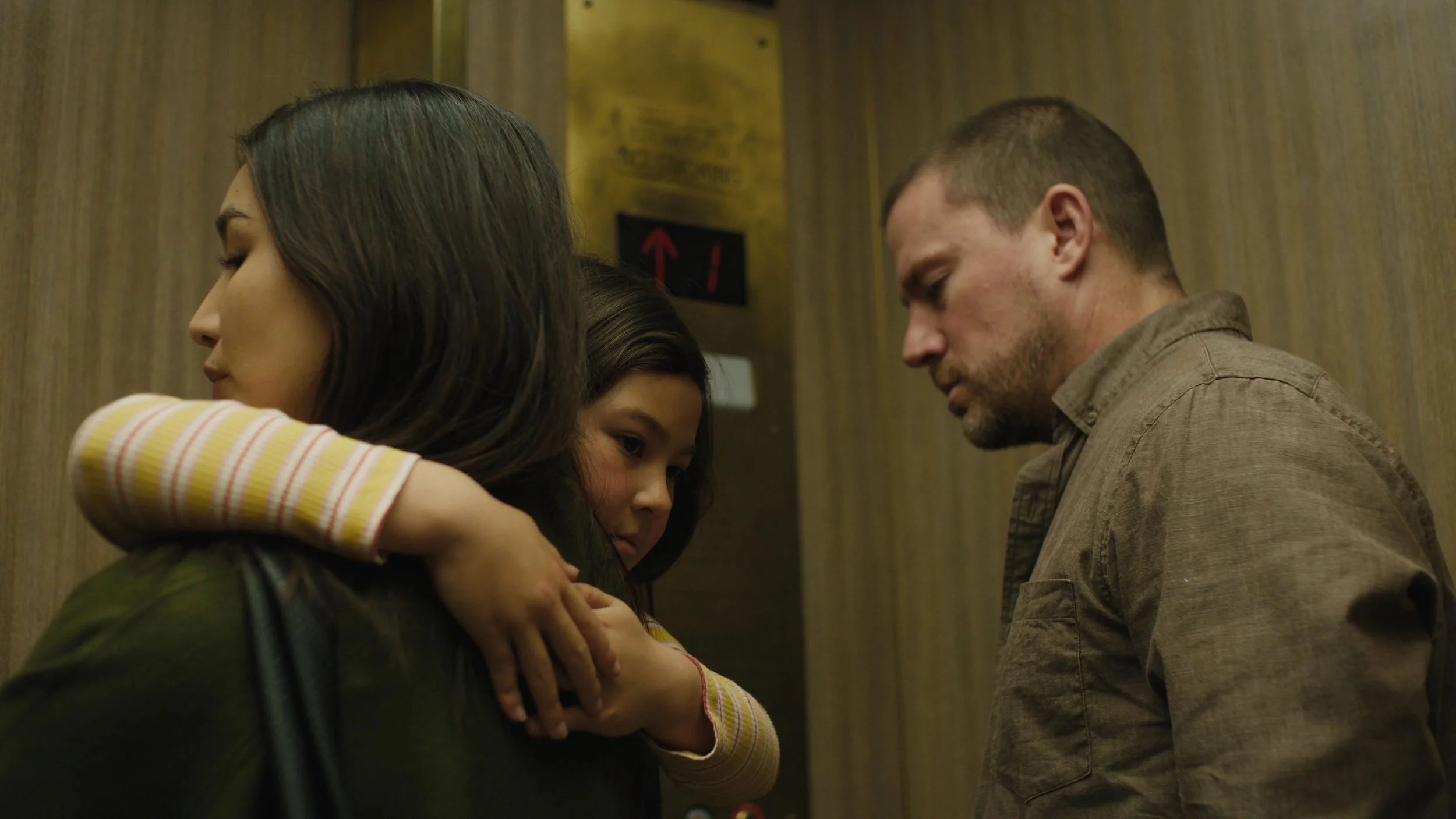
The saddest part of the movie is when Josephine sees her parents being close. Her trauma has altered her perception of how men and women interact to the extent that she panics and physically pushes Damien away from Claire, believing that her father is hurting her mother. De Araújo takes a heartbreaking picture of all three faces: Josephine's fear, Damien's hurt and confusion as he tries to explain that he wasn't hurting Claire, and Claire's desperate attempt to calm her daughter's fears. It's a masterclass in how trauma from childhood that isn't dealt with doesn't just hurt the child; it also hurts the whole family.
Adults around Josephine doesn't always understand how her trauma shows up. At school, she lashes out and fights back against a bully, making it clear that he can't touch her without her permission. She has learned the language of bodily autonomy, but without the right help, it comes out as aggression instead of empowerment. She doesn't want to talk to Claire because she doesn't need to, but because the framework for the conversation was never set up right. Before telling her how she should feel, she needed someone to ask her how she felt.
Tatum gives a surprisingly nuanced performance as Damien, showing that he can do more than just his usual roles. He's a father who desperately wants to protect his daughter but has no vocabulary for the kind of protection she actually needs. In scenes with Tatum, where she insists their daughter needs a safe space to talk about what she saw and that the changes in her behavior are direct results of unprocessed trauma, Chan beautifully balances nurturing warmth toward Josephine with steely strength.
The courtroom sequences reveal another layer of institutional failure. Josephine's testimony is strong and self-assured—she does everything "right"—but the film wisely refuses to show us a verdict. The outcome of the trial isn't the point. What matters is that it took a formal legal proceeding to give Josephine a space where adults finally listened to her voice, something her home should have provided from the beginning.
The film does stumble in its middle act, where Josephine's acting out takes perhaps too long to crystallize into the clear trauma response it is. For a stretch, the pacing meanders before fully connecting the dots between her behavioral changes and her unaddressed trauma, making the film's central thesis feel less sharp than it could be.
But de Araújo's film announces a filmmaker unafraid to interrogate uncomfortable truths about how we handle childhood trauma. Miles Ross's beautiful score provides emotional texture without manipulation, supporting rather than dictating our feelings. And Reeves proves herself a formidable talent, carrying the entire film on her young shoulders while making Josephine's confusion, fear, and eventual strength feel achingly real.
The film ends with Damien and Josephine running together, playing soccer. She appears stronger now; he's still processing everything. It's a moment of healing and reconnection, but it's also a quiet indictment—the bonding Damien tried to force through sports finally happens, but only after Josephine was heard elsewhere first. The activity became what he intended only after the family's approach fundamentally shifted.
"Josephine" is important because it won't let us ignore the fact that kids are intuitive. They see, they know, and they remember. When we don't give them time to process what they've seen—when we redirect, downplay, or assume we know what they need without asking—we make their trauma worse in ways that change how they see safety, intimacy, and trust.
This movie is a must-see for parents who have to talk to their kids about hard things, teachers who need to learn how to spot trauma responses, and anyone who works with young people who have seen violence. The movie asks its audience to sit with their discomfort, realize that noble intentions aren't enough, and understand that sometimes the best thing we can do for a traumatized child is to simply ask, "How are you feeling about all of this?"
"Josephine" is currently screening at the 2026 Sundance Film Festival.