Sirat Review: Lost in the Desert, Empty in the End
A Review by Kathia Woods
★★★| Directed by Oliver Laxe | 114 Minutes| in limited release in the United States
Oliver Laxe's Sirat has a lot of festival history behind it. It won the Cannes Jury Prize and has a pulsating techno soundtrack and beautiful shots of Morocco's Sahara Desert. But underneath its technical skill is a lack of substance; it's a movie that confuses brutal shock with emotional depth. What starts as a father's desperate search for his missing daughter turns into a punishment for the audience without any reason for us to care.
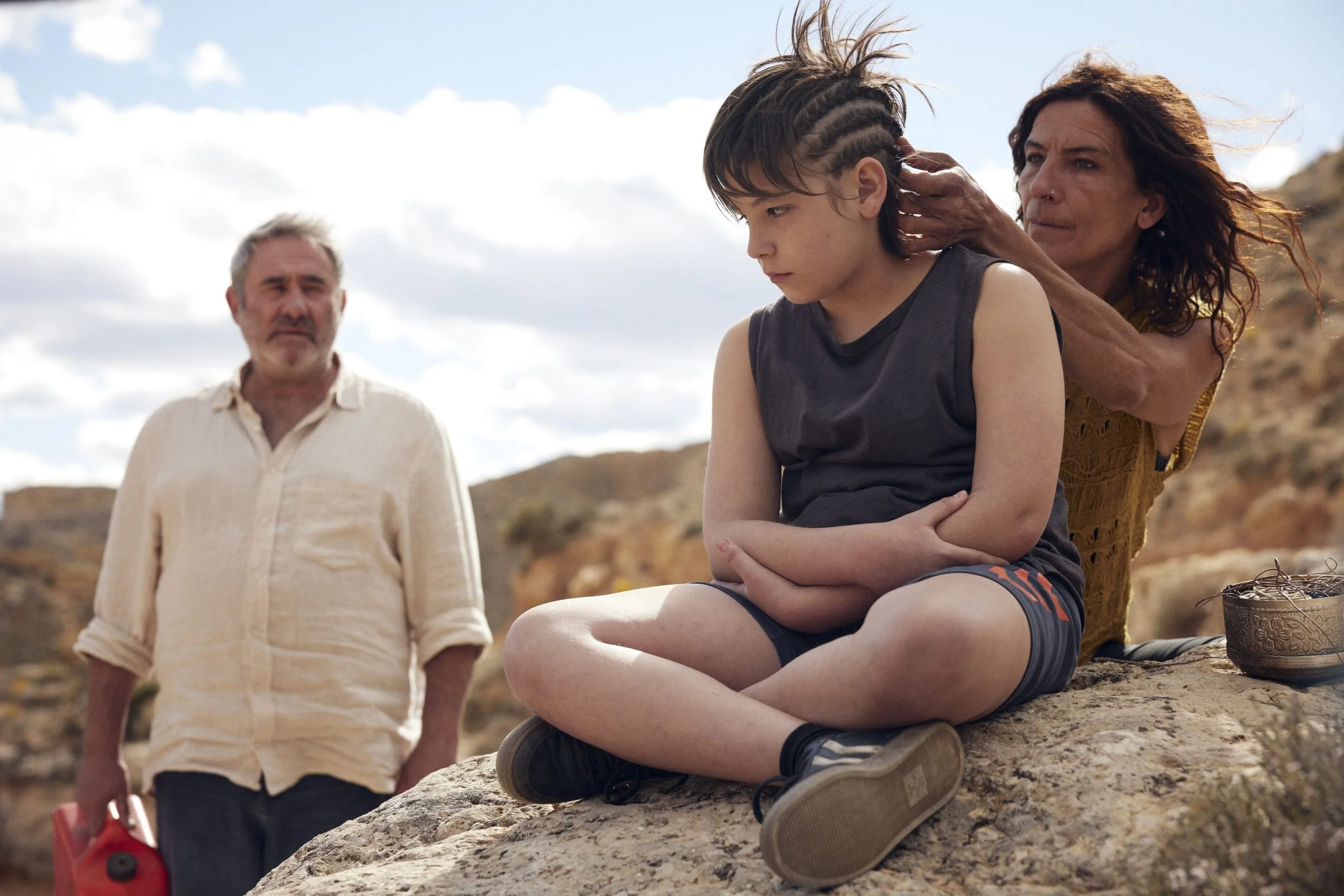
Luis, played by Sergi López with a quiet sense of desperation, goes to an illegal desert rave with his young son Esteban (Bruno Núñez Arjona)and hands out flyers for his missing daughter Mar. Luis hopes she'll show up at the next party because she disappeared five months ago at one of these parties. Luis follows a group of traveling ravers deeper into the desert toward another gathering, pulling his son through more and more dangerous terrain in search of a ghost. The idea is interesting: a man who won't accept what seems to be inevitable and is grasping at anything, every rumor and possibility.
But Laxe never lets us feel Luis's pain or see Mar as anything more than a plot device. We don't learn much about who she was, why she got involved in this subculture, or how she got along with her father before she went missing. Luis's obsession seems strange and empty, like it's more of a story obligation than something he's actually lived through. The movie puts more emphasis on the atmosphere than on the characters' inner lives. It gives us beautiful wide shots and hypnotic rave scenes, but it doesn't let us into the emotional core that could make any of this matter. His search feels more like a machine than a heartbreaking one. It's like a father going through the motions without the deep feelings that should come with such a terrible loss.
The rave group—Tonin (Tonin Janvier), Jade (Jade Oukid), Bigui (Richard Bellamy), Stef (Stefania Gadda), and Josh (Joshua Liam Henderson)—have some surface-level quirks, but they are still impossible to know. They live in a world that has already ended, where wars are going on in the background and society is falling apart. However, Laxe's refusal to give them a backstory means that they are more like symbols than real people. We see moments of connection, like when people share jokes or dance together, but we never go deeper than that. When tragedy strikes with unending violence, we are left numb instead of devastated because we didn't know these characters well enough to miss them.
Then comes the film's famous middle twist, when Laxe takes away any sense of safety or predictability. What comes next is an allegory that is so blunt it almost seems rude. Characters are put through more and more horrible things, like landmines, betrayals, and deaths that seem to be meant to shock rather than come from the characters or the story. The missing daughter, who is supposed to be the main character, is pushed to the side while Laxe talks about his metaphors for the narrow bridge between heaven and hell. Luis has lost everything by the end of the movie: his son is dead, his dog is gone, and he has no hope of finding Mar. But the movie's harsh nihilism comes across as mean-spirited instead of deep. The shocking violence seems unnecessary, used to shock rather than explain.
The soundtrack by Kangding Ray deserves praise; the pulsing techno won Best Soundtrack at Cannes for a good reason. But even this amazing sound can't make up for the story's lack of connection. Mauro Herce's cinematography is also stunning; he captures harsh desert light, ochre cliffs, and dust storms with painterly precision. But beauty without an emotional anchor is just decoration.
People who like the movie will say that Laxe's refusal to give the usual catharsis is exactly what the movie is about. But there is a difference between meaningful ambiguity and just not saying anything. Sirat uses shocking violence as if being cruel is the only way to make art.
When the movie ends with Luis having lost everything and found nothing, we don't feel sad; we feel empty. Not because Laxe took us on a scary journey, but because he never gave us anyone to really care about. No matter how well it was filmed, shock without emotional investment is just noise. Sirat is a technical wonder that serves a void.