Sound of Falling Is a Haunting Masterwork That Rewrites the Rules of Cinema
by Kathia Woods
There are films that entertain, films that provoke, and then there are the rare ones that permanently reconfigure how you see the world. Sound of Falling, the sophomore feature from German writer-director Mascha Schilinski, belongs firmly in that last category. Winner of the Special Jury Prize at Cannes and shortlisted for the Oscar for Best International Feature Film, this extraordinary work announces Schilinski as one of the most vital cinematic voices working today.
The film weaves together the lives of four young women — Alma in the 1900s, Erika in the 1940s, Angelika in the 1980s, and Lenka in the present — each coming of age on the same remote farmstead in northern Germany's Altmark region. Rather than tracing a conventional family saga, Schilinski constructs something far more daring: a living, breathing collage of memory, inheritance, and the silences women carry from one generation to the next. The result plays less like a linear narrative and more like discovering a century's worth of private journals stashed inside the same farmhouse walls.
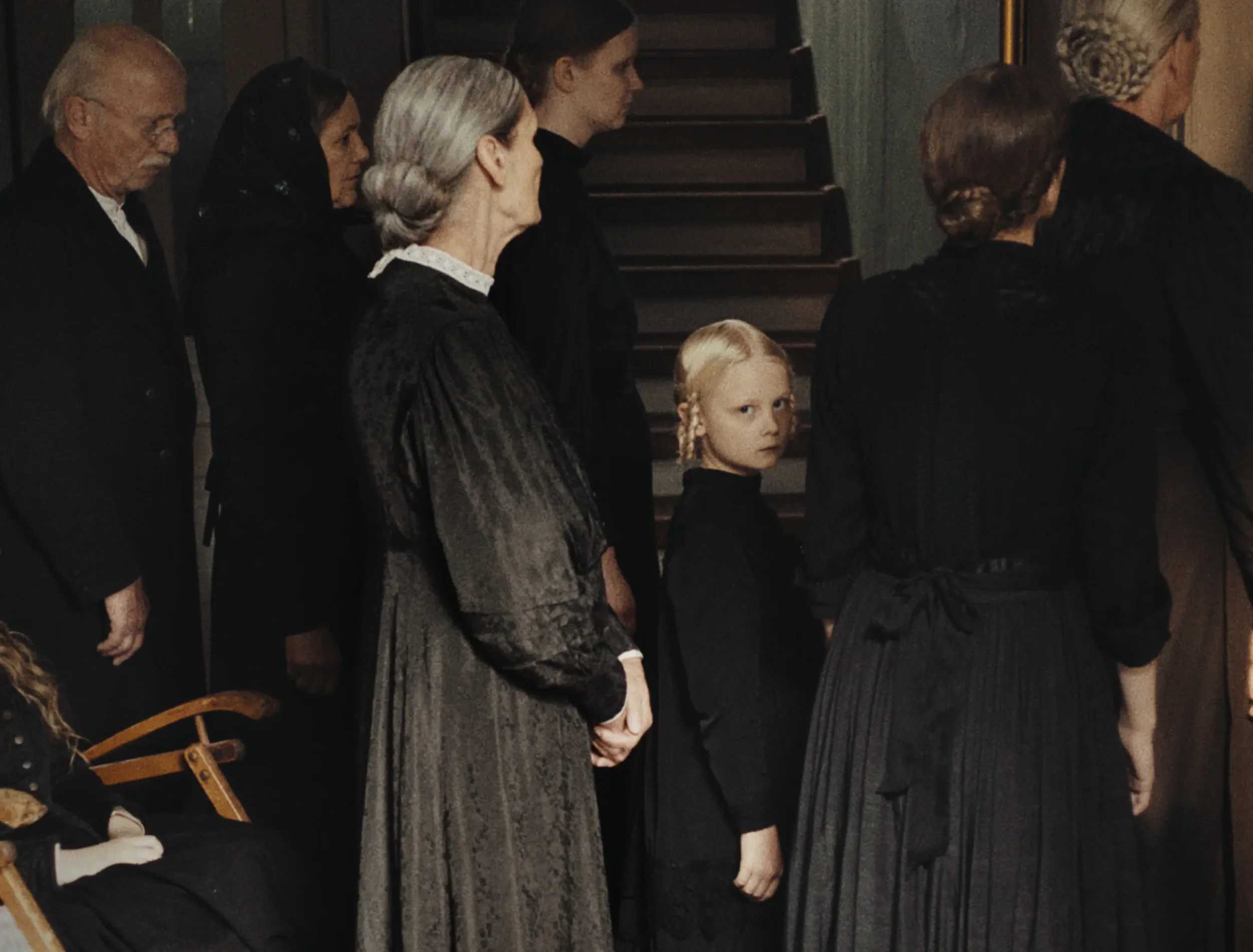
What immediately seizes you is the film's visual language. Cinematographer Fabian Gamper shoots in a constricted Academy ratio, using naturally sourced light to conjure textures that evoke aged daguerreotypes and oxidized mirrors. Images arrive with the grainy, half-remembered quality of something dreamed rather than lived — deliberately, brilliantly so. Schilinski's camera doesn't observe these women so much as haunt them, slipping between doors, hovering at the edges of rooms, watching the way grief and rebellion look on a body before they've found their proper names. It is gorgeous, deliberately unsettling work.
The sound design deserves equal credit. Composers Michael Fiedler and Eike Hosenfeld, alongside a meticulous sound team, build a sonic landscape that functions almost as a fifth character — layering static, silence, and the recurring needle-drop of Anna von Hausswolff's woozy "Stranger" to collapse the distance between decades. The ominous droning rush that gives the film its title appears without warning, a physical sensation as much as an auditory one, reminding us that falling — into grief, into desire, into erasure — has always had a sound. We've just been trained not to hear it.
The ensemble is remarkable. Nine-year-old Hanna Heckt as the youngest Alma is a revelation, conveying the weight of a child who has already absorbed too much of the world's darkness with a calmness that is quietly devastating. Across all four eras, the performers find a shared emotional frequency — a common tremor of longing and suppressed rage — that makes the film's non-linear structure feel intuitively coherent rather than needlessly obscure.
Make no mistake: Sound of Falling demands something from its audience. The 149-minute runtime is dense, its time-jumping disorienting in the first hour, and some viewers may find its unrelenting emotional weight difficult to bear. The film does not soften its portrayal of the cruelties women have absorbed across history, nor does it offer tidy resolution. But that refusal is precisely the point. Schilinski isn't interested in rescuing her characters from the cycles that constrain them — she's interested in making those cycles visible, tangible, and impossible to dismiss.
This is a film about what gets passed down through women's bodies when language fails them: impulse, rebellion, the baffling physics of desire and grief that the men around them keep calling irrational. Each generation adds more color to the palette, even as the shadows deepen. By the final frame, you may not fully understand everything you've witnessed — but you will feel it. That, in the end, is what only the very best cinema can do.
Sound of Falling is now streaming on MUBI. ★★★★½