Dossier 137 — A System Under Scrutiny
by Kathia Woods
★★★★/5
French director Dominik Moll has built a quiet reputation as one of Europe's most precise storytellers of moral ambiguity, and Dossier 137 — which premiered in competition at the 78th Cannes Film Festival before finding North American distribution — confirms that his instincts remain sharp, even when his execution plays it safer than expected.
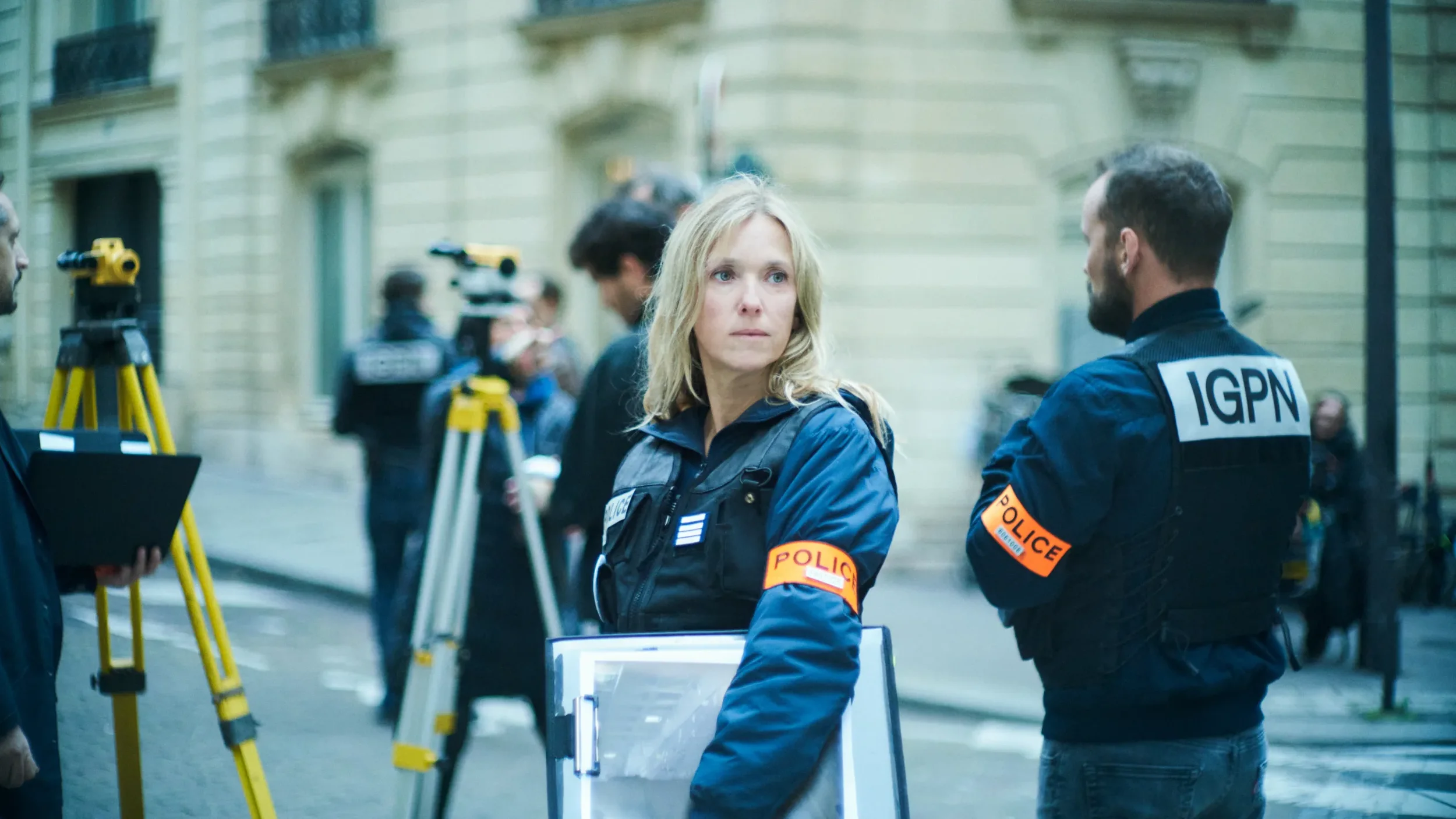
The film drops us into the aftermath of the 2018 Yellow Vest protests in Paris, one of the most consequential moments of civil unrest in modern French history. A young man is struck in the head by a flash-ball projectile fired by police — a weapon whose use against protesters violated widely accepted standards of conduct. The case lands on the desk of Stéphanie Bertrand (Léa Drucker), an investigator with the IGPN, France's equivalent of Internal Affairs. What follows is a meticulous procedural about one woman's attempt to hold the institution she belongs to accountable.
Drucker is the film's undeniable anchor. Her performance is precise without being cold, principled without being preachy. She plays Stéphanie as a woman who knows exactly what the system is designed to protect — and pursues the truth anyway, not out of naivety, but out of a refusal to be complicit. The film complicates this nicely when the case takes a personal turn, as Stéphanie discovers the victim has ties to her hometown. Suddenly, this isn't just dossier number 137. It has a face, a family, a weight.
Moll, who co-wrote the script with long-time collaborator Gilles Marchand, brings the same meticulous research to this project that distinguished their runaway hit The Night of the 12th (2022). He reportedly spent significant time with actual IGPN investigators to get the procedures and institutional language right — and it shows. The film feels lived-in rather than performed.
Where Dossier 137 earns its most uncomfortable power is in the third act, when the lies of the officers involved are exposed clearly and yet rendered essentially toothless by the machinery of institutional self-protection. It's a study of police violence and corruption that writes itself into a corner and then, brilliantly, forces us to sit there. Stéphanie's simmering rage becomes ours, and the film's final thesis — that good cops are quietly idealistic even beneath their cynical exterior — lands with more ambivalence than comfort.
For American audiences, particularly Black American audiences, the resonance will be immediate. The "blue wall of silence," the bureaucratic neutralization of accountability, the personal cost borne by the officer who refuses to look away — these aren't French problems. They're a universal language. The fact that the investigator here is a woman navigating a heavily male institution adds another layer of tension that Moll and Drucker handle with care.
Guslagie Malanda, memorable from Saint Omer and La Bête, surfaces as the key witness who holds the thread Stéphanie needs — though the film keeps her at a distance that limits her impact. And at times, the no-frills visual style works against the film, giving it a procedural flatness that blunts what could be a more visceral gut punch.
Still, Dossier 137 is exactly the kind of cinema that matters — not because it delivers easy catharsis, but because it refuses to. It sits with you after the credits roll, asking uncomfortable questions about where justice actually lives and who it's designed to serve.
Dossier 137 (Case 137) is distributed in North America by Film Movement. Runtime: 115 minutes. In French with subtitles. Rated NR.