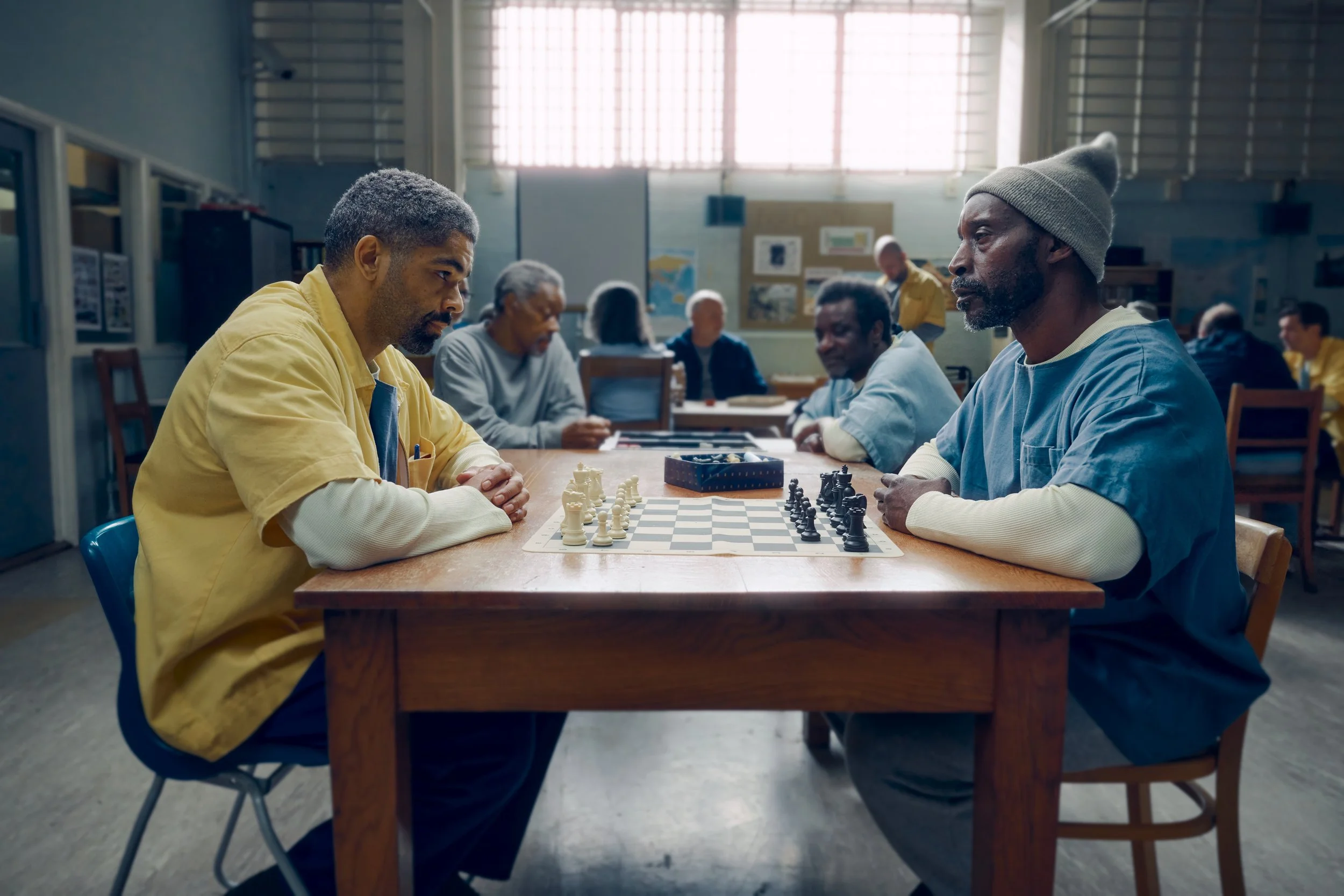
Frank & Louis: Finding Redemption Through Compassion
by Kathia Woods
In the harsh world of America's prison system, where punishment usually comes before any thought of rehabilitation, Frank & Louis dares to ask a quietly radical question: Can caring for someone else heal the caregiver? Petra Biondina Volpe's understated prison drama gives a resounding yes, making it one of the most emotionally powerful films at Sundance.
Kingsley Ben-Adir gives Frank, a lifer in prison for murder who volunteers for the prison's geriatric care program, a lot of depth. At first, he does it as a strategic move to get parole. His job is to look after Louis (Rob Morgan), a prisoner who used to be feared but is now suffering from early-onset dementia and swings between paranoid confusion and brief moments of clarity. What could have been a simple story of redemption turns out to be much more complicated and deeply human.
Volpe, known for her sensitivity to overlooked stories, strips away the typical violence and machismo of prison cinema. There are no riots, no shower confrontations, and no dramatic standoffs with guards.
Instead, she focuses on the small, unglamorous tasks that come with caring for someone, like the patience it takes to calm a scared man, the dignity that comes from helping someone bathe, and the small victories that come from sharing a meal. The movie's best feature is its intentional quietness, which gives the actors room to give performances that will define their careers.
Ben-Adir, whose range has impressed in everything from One Night in Miami to Marvel's Secret Invasion, shows new depths here.
His Frank is neither saint nor irredeemable monster but a man confronting the weight of his past while discovering unexpected capacity for tenderness.
Pay attention to how his body language changes during the movie. At first, he's guarded, but then he shows real concern, and his hands learn how to be gentle. It's a masterclass in how to slowly change a character.
Morgan matches him beat for beat, and he does it with heartbreaking honesty as she deals with Louis's mental decline. The veteran character actor shows both the fear of losing oneself and the flashes of the strong man Louis used to be. The chemistry between them is electric, which is rare in dramas about men, let alone prison movies.
In a remarkable and unexpected turn, René Pérez Joglar—known globally as Residente, the Puerto Rican rapper and cultural icon—delivers a stunning dramatic performance as Julian, another inmate in the care program. Pérez Joglar, who is directing his first feature film, imbues a potentially one-dimensional role with significant depth and emotion. Julian is both a mirror and a foil for Frank. He has to deal with his reasons for wanting this job and the ghosts that haunt him. The scenes between Ben-Adir and Pérez Joglar show a different kind of masculine tenderness, as two men become friends by caring for those who have been forgotten. It's a performance that reveals a serious acting talent beyond music, showing that Pérez Joglar's artistic reach goes far beyond his fame in Latin music.
The way the movie talks about memory is very moving. As Louis loses touch with his past, Frank has to deal with his own: the crime that brought him here, the person he used to be, and the person he could still become. Volpe makes comparisons between Louis's unintentional forgetting and society's intentional forgetting of people in prison. He asks if either of them serves justice.
Frank & Louis is different because it doesn't give easy answers. Frank's growing compassion doesn't make up for what he did. Louis's weakness doesn't make the crime that got him in jail any less serious. The parole board that Frank will face in the future doesn't mean that change will set him free. This moral ambiguity changes the movie from a feel-good story to something more real and, in the end, more hopeful.
Cinematographer Judith Kaufmann bathes the prison in muted, naturalistic tones that somehow find beauty in institutional grimness—golden light filtering through barred windows, shadows softening harsh concrete. The visual poetry never overwrites the story's grounded realism.
The sole problem is that the minor characters are underdeveloped, and the plot focuses primarily on Frank. However, the film's intense attention forces viewers to consider how connections can significantly alter a person's existence.
Frank & Louis arrives at a critical juncture in the continuing debate over revamping the criminal justice system and the treatment of jailed people. Without being excessively preachy, it makes a persuasive case that punishment and rehabilitation can effectively coexist.
Even in the harshest places, compassion can grow if it is given room.
Volpe made a movie that trusts its audience to deal with discomfort, accept uncertainty, and realize that redemption is not a goal but a way of life. Frank & Louis is the best kind of quiet, patient movie. The whole cast gives amazing performances, and the movie will stay with you long after the credits roll.