
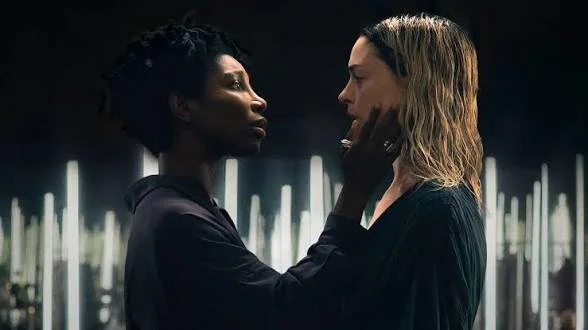
Two types of films exist: those that amuse and those that terrify.David Lowery's Mother Mary, the latest from the house of A24, belongs firmly and definitely in the latter category. Equal parts psychodrama, gothic fairy tale, and art-pop spectacle, the film is a singularly strange, hypnotic experience that will divide audiences and electrify those willing to surrender to its rhythms. And at its center, doing some of the most riveting screen work of her already extraordinary career, stands Michaela Coel.
The film follows iconic pop star Mother Mary (Anne Hathaway), who reunites with her estranged best friend and former costume designer Sam Anselm (Michaela Coel) on the eve of her comeback performance after a crisis of identity forces her to seek the one person she cannot replace. Essentially a two-hander, the film marries the most elaborate of music videos and concert sequences with an intimate portrait of two human beings coming back together, however awkwardly, for the love of art after nearly a decade of estrangement.
Lowery the visionary behind The Green Knight and A Ghost Story—has never been a director who colors inside the lines, and Mother Mary represents his most audacious swing yet. Singular, hypnotic, and formally unbound, the film is staged largely within a cold, unheated barn somewhere outside of London, yet it grows to feel as vast as the space that stretches between literalness and metaphor. He layers surrealistic imagery over an intimate two-person confrontation, borrowing the visual grammar of high-fashion editorials, gothic horror, and arena-pop spectacle. The moody lighting and florid dialogue create an intoxicating atmosphere, as Lowery adds surrealistic elements that give the film an air that draws you in and never lets you go. The result is disorienting and deliberately so—a film that demands you feel before you understand.And then there is Michaela Coel.
The I May Destroy You creator and star has always possessed an almost supernatural ability to command a frame, but her work as Sam Anselm is a revelation. Sam discovers that she is more emotionally attached to Mother Mary than she anticipated or desired, and Coel effectively balances bitterness and vulnerability.The beguiling ambiguity at the heart of the character becomes even more pronounced given Coel's ability to play multiple emotions at once—it is a completely transfixing performance, as effective when she is silently staring daggers as when she is spitting out the screenplay's most venomous dialogue.
With pinpoint accuracy, Coel interweaves all of Mary's lines while Sam speaks with a sugary sweetness that reaches deep into her skin. There is nothing showy about it, which is precisely what makes it so devastating. She is all stillness and precision, a woman whose rage has calcified into something almost architectural. She knows how to use her penetrating eyes and commanding presence to project an insinuating perception, the sense that she is reading her antagonist like a psychic.
Hathaway, for her part, is committed and genuinely compelling. The fierce precision and command she displays onstage melt away to reveal a scared, uncertain woman caught in a current pulling her far from solid ground. The original songs, crafted by Jack Antonoff and Charli XCX, carry a trance-like pull, and Hathaway performs them with total conviction. But it is Coel who owns this film from the inside out.
Mother Mary is not for the passive viewer. It is a film that asks something of you — patience, attentiveness, a willingness to sit with ambiguity. Those who show up to that challenge will find something genuinely rare: a big-studio art film that swings for the avant-garde and lands with both fists.
Mother Mary is playing in theaters worldwide