Rio Beyond the Postcard:
What the Tourist Gaze Misses About a City That Is Not Brazil
It is not Christ the Redeemer. It is not Sugar Loaf. It is not Carnival, and it is not all of Brazil. The real Rio de Janeiro lives in Zona Norte — and it is time to redirect the gaze.
sk most international travelers what they know about Rio de Janeiro and the answers arrive in a predictable rush: Christ the Redeemer, Sugar Loaf Mountain, Copacabana Beach, Carnival, and samba. Ask them what they know about Brazil, and you will often receive the same list — as if one city, one coastline, and one week in February constitute an entire nation of 215 million people spread across a landmass larger than the continental United States. It does not. It never did. And Rio itself deserves far better than this reduction.
This is not a travel piece. It is a cultural reckoning. A refusal to participate in the ongoing flattening of one of the world's most layered, complex, and alive cities into a handful of tourist symbols that serve primarily one sliver of its geography. The Rio de Janeiro that global media, travel brands, and film productions have agreed to show the world is largely Zona Sul — the wealthy southern zone that cradles Ipanema, Leblon, and Copacabana. It is beautiful. It is real. And it is only one face of a city that wears many.
The First Correction
Rio Is Not Brazil
Let us begin with the most persistent myth: the conflation of Rio de Janeiro with Brazil itself. This is a colonial legacy dressed in contemporary tourism marketing. Brazil has not been governed from Rio since 1960, when the capital was relocated to Brasília. The country is home to 26 states and a federal district, each carrying its own music, cuisine, dialect, cultural lineage, and identity. The rhythms of Recife are not the rhythms of Manaus. The terreiro culture of Salvador is not interchangeable with the Japanese-Brazilian community of São Paulo's Liberdade neighborhood. The Amazonian worldview of Belém is not the gaucho traditions of Porto Alegre.
Treating Rio as a stand-in for all of Brazil does not merely erase those other realities — it actively misrepresents them. It is the equivalent of reducing the United States to Los Angeles or New York and calling it a day. A visitor who spends a week in Ipanema has experienced one corner of one city in one of the most geographically and culturally diverse nations on earth. That is worth naming directly.
"The Rio that global media agreed to show the world is largely Zona Sul. It is beautiful. It is real. And it is only one face of a city that wears many."
The Second Correction
The City Has a North Side — and That Is Where the Soul Lives
Zona Norte is not the back of Rio. It is the backbone of Rio. The neighborhoods that stretch north of the city center — Madureira, Tijuca, Méier, São Cristóvão, Oswaldo Cruz, Andaraí, and beyond — are where the majority of cariocas actually live, work, and build culture. They are also where the cultural traditions that the world associates with Rio were born, nurtured, and carried forward by Black and working-class communities who have rarely received credit for what they created.
This is not a recent oversight. It is a structural one, rooted in the same hierarchies — racial, economic, geographic — that have shaped Brazilian society since the colonial period. When those hierarchies travel abroad embedded in tourism campaigns, film shoots, and travel journalism, they do not lose their politics. They export them.
70%of Madureira residents are of African descent
~3MBlack residents in Rio — nearly half the city's population
1923 Portela founded in Zona Norte — Rio's oldest samba school
Zona Norte | Madureira
The Black Mecca That Tourism Forgot
Forty minutes from Copacabana — a distance that might as well be another planet in the imagination of most travel itineraries — sits Madureira. Its population of over 300,000 is approximately 70 percent Black. It is widely recognized as the "Black Mecca" of Rio de Janeiro, the beating heart of Afro-Brazilian culture in a city built on the labor, spirituality, music, and resistance of its African descendants. And it rarely tops a tourist list.
Madureira's cultural DNA was shaped in the early 20th century, when freed Black people displaced from the city center by a brutal gentrification process settled in what was then a distant suburb and made it their own. They brought their music, their faith, and their community structures. They founded samba schools. They built Umbanda terreiros — spiritual centers where Afro-Brazilian religious traditions connecting indigenous, African, and Catholic elements continue to be practiced to this day. They created Mercadão de Madureira, a century-old market now recognized as intangible cultural heritage, where vendors sell herbs, dendê oil, Afro-Brazilian religious goods, and the ingredients of a cuisine shaped by the African diaspora.
Today, Madureira is also where Afro-Brazilian millennials gather at venues like Viaduto de Madureira and Casa Black, where R&B, hip-hop, and funk blend seamlessly with samba roots. Parque Madureira on Sundays functions as a vast open-air community celebration — one visitor described it as "a huge Afro-Brazilian block party." The neighborhood is home to Black-owned businesses, political organizations like CUFA (Central Union of the Favelas), and a creative community that is actively making culture rather than curating it for outside consumption.
Zona Norte | Samba Schools
Portela, Império Serrano, and the Origin Story That Got Reassigned
Here is a fact that deserves repeating: samba did not come from Ipanema. Bossa nova, that cool, refined, coastal sound that the world fell in love with in the late 1950s, was born in Zona Sul apartments and seaside bars — and the global popularity of bossa nova subsequently shaped how the world imagined Rio's music. But samba, the deeper, older, more communal root from which so much Brazilian music grew, came from the terreiros and community gatherings of Zona Norte, from the working-class Black neighborhoods that the tourist gaze has consistently looked past.
Portela — founded in 1923 in Oswaldo Cruz, a Zona Norte neighborhood — is the oldest samba school in Brazil and the most decorated, having claimed 22 Carnival championship titles. Its history, as one observer has noted, is the history of Black cariocas finding shelter, strength, and direction in a city shaped by slavery. The school carries the names of Paulo da Portela, Paulinho da Viola, Monarco, and Dona Ivone Lara — architects of samba's literary and musical tradition whose legacy is inseparable from the community that raised them.
Império Serrano, headquartered in Madureira since its founding in 1947, holds nine Carnival championships and a compositional legacy that is equally remarkable. Its Ala de Compositores — the school's composers' wing — has included some of the most significant figures in Brazilian popular music. Notably, Dona Ivone Lara became the first woman to participate in the composers' wing of any samba school, a breakthrough that took place at Império Serrano. These institutions are not entertainment venues. They are community anchors, cultural archives, and living expressions of Afro-Brazilian resistance and joy.
Portela
Founded 1923 in Oswaldo Cruz. Rio's oldest and most decorated samba school with 22 Carnival titles. Its quadra in Madureira hosts Friday night rehearsals open to the public — an immersive experience no museum can replicate.
Império Serrano
Founded 1947 in Madureira. Nine-time champion. Home to Dona Ivone Lara, the first woman in any samba school's composers' wing. The school's samba-enredo tradition is considered among the most literary in Rio's Carnival.
Zona Norte | São Cristóvão
The Fair That Proves Rio Belongs to the Whole Country
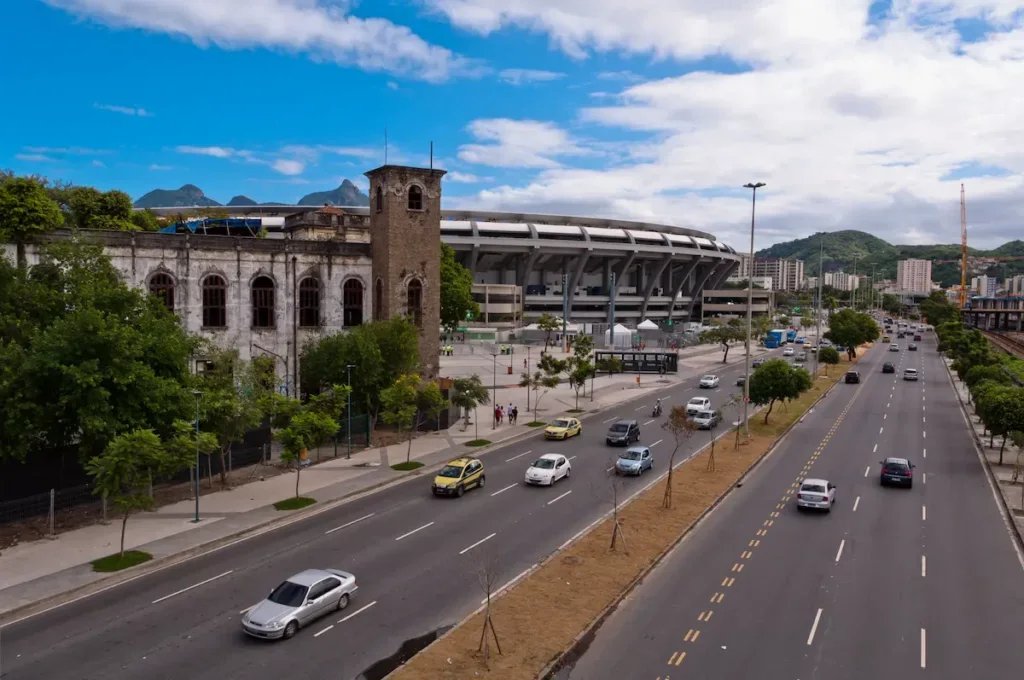
There is an argument to be made that the most Brazilian place in Rio de Janeiro is not the Sambadrome, not Lapa, and certainly not the beachfront promenade of Ipanema. It is a pavilion in São Cristóvão that looks, from the outside, like a football stadium. Inside the Centro Luiz Gonzaga de Tradições Nordestinas — the São Cristóvão Fair — nearly 700 stalls offer the foods, crafts, music, and community of Brazil's Northeast: a region that, despite being home to tens of millions of Brazilians, is consistently invisible in the country's international image.
The fair's origins trace to 1945, when a wave of Northeastern migrants, known as nordestinos, arrived in Rio to work in civil construction and settled in the São Cristóvão neighborhood. They gathered informally, recreating the markets and music of Bahia, Pernambuco, Ceará, and Paraíba. What began as weekend gatherings of displaced workers became, over decades, a cultural institution. In 2003 it was officially formalized; it has since been recognized as Intangible Cultural Heritage of Brazil and, more recently, declared Historical, Tourist, Cultural, and Gastronomic Heritage of the State of Rio de Janeiro. The fair's name honors Luiz Gonzaga, the accordionist from Pernambuco known as the King of Baião, who brought the music of the Northeast to national consciousness.
To walk through the São Cristóvão Fair is to understand, viscerally, that Rio is a city of migrations, absorptions, and cultural layering. The forró stages, the carne seca, the cordel literature, the repente poets who improvise verse in response to the crowd — none of it is Carioca in origin. All of it is entirely at home here. This is what cosmopolitan actually looks like: not a beach shared by international tourists, but a city that holds the whole country within its borders.
✦ ✦ ✦
Zona Norte | Tijuca
The Neighborhood Where the City Exhales
Tijuca is where many middle-class cariocas actually live — the kind of Rio neighborhood that does not photograph as dramatically as Zona Sul but sustains the daily life of the city. It is home to the Tijuca Forest, one of the largest urban forests in the world, whose green canopy visible from across the city is often aestheticized in establishing shots of Christ the Redeemer without acknowledgment of the living neighborhood it shelters. Tijuca's botecos — neighborhood bars where cold chopp and feijoada are served to regulars who know each other by name — are where Rio's weekday rhythms play out, unhurried and largely uncurated for outside eyes.
To the east lies the Quinta da Boa Vista, a sweeping park on the grounds of what was once the Imperial Palace of Brazil. It housed the Brazilian royal family through the 19th century and today contains the National Museum — a reminder that Rio's relationship to Brazilian political and intellectual history is layered in ways that the postcard never acknowledges. The neighborhood of São Cristóvão, where the fair is held, was once Rio's imperial quarter. History here is not decoration; it is address.
Afro-Brazilian Culture
Pequeña África and the Cradle of Samba
For those willing to move beyond Zona Norte into the historic center, the neighborhood once known as Pequena África — Little Africa — offers another layer of the city's suppressed history. Pedra do Sal, situated in the Saúde neighborhood near the port, is identified as the cradle of urban carioca samba. It was here, on rocky ground near the waterfront, that freed and enslaved Africans gathered after slavery's abolition to play samba, practice capoeira, and build the culture of resistance and joy that would eventually become Brazil's greatest cultural export.
Today, Pedra do Sal hosts open-air samba parties. Friday nights bring out Roda de Pedra and the neighborhood faithful. It is a place that carries the weight of what it witnessed — salt extracted from enslaved workers, community forged in its aftermath — while remaining genuinely alive, not merely preserved. The Church of Nossa Senhora do Rosário e São Benedito dos Homens Pretos nearby, founded by Catholic brotherhoods of enslaved and freed Black people, houses the only museum in Rio dedicated to Afro-Brazilian history. Its patron saint is Black. Its walls hold what centuries tried to erase.
"To walk through the São Cristóvão Fair is to understand, viscerally, that Rio is a city of migrations, absorptions, and cultural layering. This is what cosmopolitan actually looks like."
On Representation
Who Gets to Define a City
The question of which Rio gets seen — and which Rio gets funded by tourism boards, film production budgets, and travel editorial — is not a neutral question. When international coverage of Rio focuses overwhelmingly on Zona Sul, it reflects and reinforces a set of racial and economic hierarchies about whose story is considered legible to a global audience, whose culture is considered aspirational, whose neighborhood is considered safe enough to visit and beautiful enough to photograph. When favelas in Zona Norte appear in that coverage, they are frequently rendered through a lens of poverty or violence that strips their residents of complexity and agency.
None of this is accidental. The tourist economy of any city involves choices about what to surface and what to obscure. Challenging those choices requires more than visiting a neighborhood off the usual itinerary — though that matters. It requires examining why the usual itinerary was drawn in the first place, and who drew it.
Rio de Janeiro is a city of more than six million people, spanning 43 administrative zones, carrying the cultural legacies of Indigenous peoples, African descendants, Portuguese colonizers, Italian and Japanese immigrants, Northeastern migrants, and generations of cariocas born into all of the above. It contains multitudes that no postcard was ever designed to hold.
It is not Brazil. And it is not what you have been shown. The city that has been waiting — in Madureira's samba courtyards, in the forró stages of São Cristóvão, in the Umbanda terreiros of Serrinha, in the boteco stools of Tijuca — is far more interesting than the one that has been sold to you. All you have to do is stop looking at the statue on the mountain and start looking at the city below it.
C