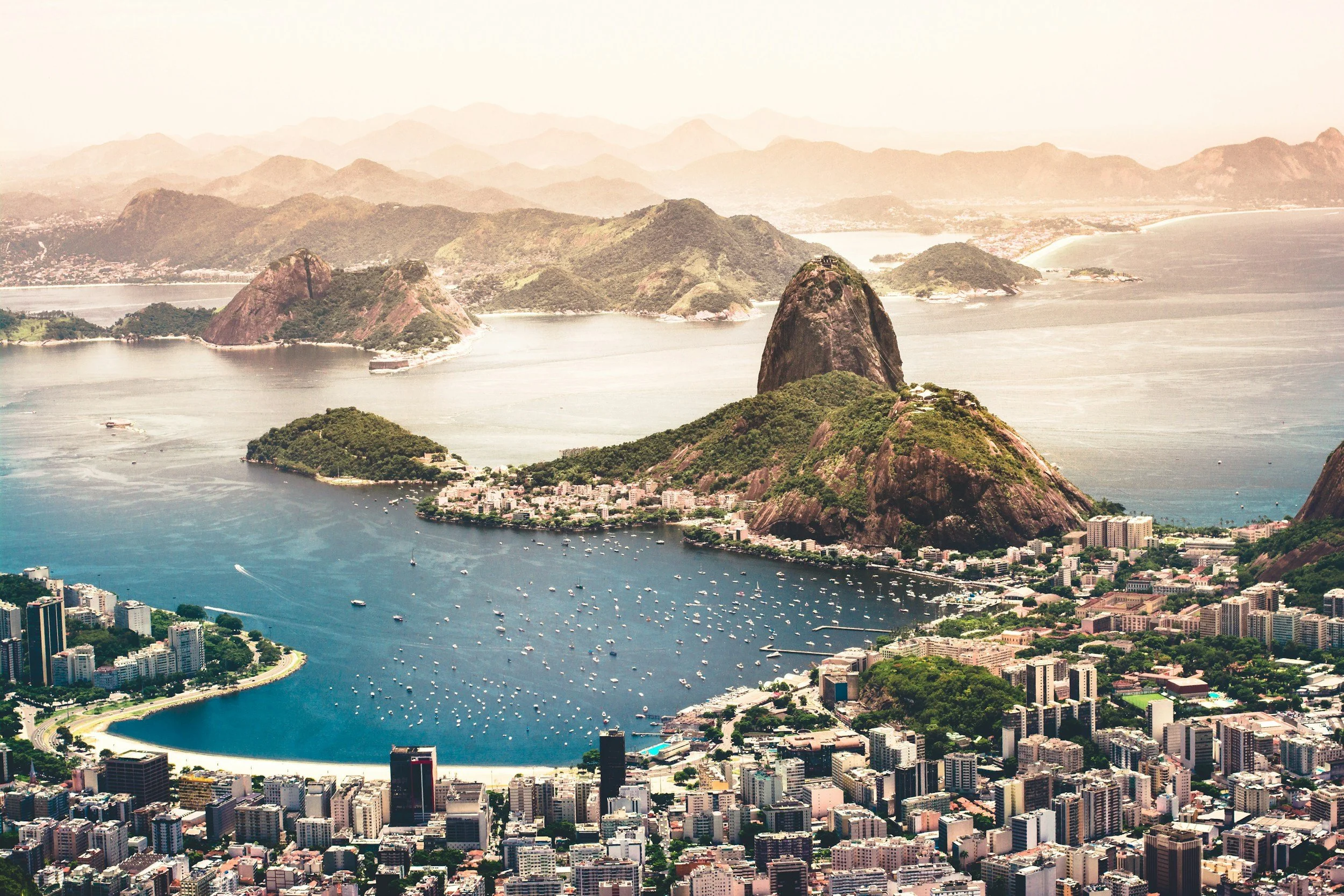
How Rio de Janeiro Shaped the Eye, the Voice, and the Soul of a Global Film Critic
by Kathia Woods
When people ask where I am from, the honest answer requires a passport, a playlist, and a pot of feijoada on the stove. I was born in Germany, raised across continents, and fundamentally shaped by a culture that I arrived at not through geography, but through blood, rhythm, and an unshakeable sense of belonging. Brazil did not simply give me heritage. It gave me a lens.
That lens did not come from a textbook or a tourist itinerary. It came from my parents—both born in Rio de Janeiro, both luminaries of the legendary performing arts collective Brasiliana. My parents inhabited the true soul of a world where Afro-Brazilian culture, music, and dance are often reduced to caricature. They were practitioners, artists, and ambassadors—not of a simplified version of Brazil, but of its deepest, most spirit-driven expression.
Brasiliana was not simply a performance group. It was a living, breathing cultural institution — a celebration of the Black Brazilian identity rooted in centuries of resilience, spirituality, and creative genius. Growing up surrounded by those artists, those rhythms, and that worldview provided an education that no classroom could replicate. Before I ever sat down to analyze a film or craft a review, I had already been taught how to read culture by the best instructors life could offer.
"Brazil did not simply give me a heritage. It gave me a lens—one calibrated by the rhythms of the favela, the light of Rio, and the spirit of a people who have always created beauty in the face of everything."
My father, Dimas, was the anchor of that world for me. His passing reshaped the geography of my summers in ways that were painful and profound in equal measure. Where once our family moved as a whole, I now travel in two directions—following my mother, who continues her life and artistry within Brasiliana, and journeying to Rio de Janeiro to spend time with my Brazilian grandparents. Those summers were an education in duality. I was learning to embrace both grief and joy simultaneously, often within the same week or even the same afternoon. It is a skill, I have come to understand, that Brazil itself has always possessed.
The Rio I knew was different from the Rio that fills foreign cinema screens — not the postcard panorama of Copacabana or the dramatic sweep of Sugarloaf at sunset. My Rio was intimate and textured. It was my grandparents' home, the sounds of the neighborhood bleeding through the windows, and the particular quality of Sunday light on a city that refuses to be still. It was Afro-Brazilian spiritual practice observed not as spectacle but as truth. It was the way my grandmother held her stories—unhurried, unapologetic, and layered with meaning.
Portuguese was my second language, arriving after German and before the English that would eventually carry my professional voice into American newsrooms and onto international stages. But Portuguese was never simply a language of communication. It was a language of feeling. German gave me precision; English gave me reach; Portuguese gave me heat. When I write in English about a Brazilian filmmaker or a Latinx performance, there is a second track playing beneath my words — one in Portuguese, one calibrated to a frequency that not every critic can hear.
"German gave me precision; English gave me reach; Portuguese gave me heat."
That frequency has significantly impacted the work. For fifteen years, I have written about film and culture for publications including the Philadelphia Tribune and the Sacramento Observer and built the Cup of Soul Show into an entertainment media platform dedicated, in no small part, to the stories that mainstream criticism habitually overlooks. The Tomatometer recognition and the Critics Choice Association membership and the NABJ Arts & Entertainment co-chairmanship—these credentials matter. But the credential that most directly shaped my critical eye cannot be placed on a resumé.
It is the memory of sitting with my mother in the wings of a Brasiliana production, watching artists channel something ancient into something alive. It is the understanding, absorbed before I could have articulated it, that culture is not decoration. It is infrastructure. It is the foundation on which people build their sense of the possible. When a film honors that truth — when it reaches into a community's particular way of being alive and renders it on screen without apology or translation — I recognize it immediately. I was trained to.
My Brazilian lens has also made me acutely sensitive to what is absent. I notice when Afro-Latinx stories are collapsed into a single, flattened narrative. I notice when the complexity of Black diasporic identity is sacrificed for palatability. I notice, because I have lived inside the fullness of what those stories can be—inside Brasiliana, inside Rio, inside my grandparents' home, and inside summers that asked me to be German and Brazilian and Black and multilingual all at once, without apology and without resolution.
There is no contradiction in that multiplicity. There never was. What it required was a critical framework expansive enough to hold it—one that I have spent fifteen years building on the page and on screen, one review, one interview, one cultural deep dive at a time.
My father Dimas gave me that framework before I knew I needed it. My mother, who is still creating and immersed in the Afro-Brazilian artistic tradition that defined their lives together, continues to refine it. Rio gave it texture and urgency. And every film I have screened since—every festival circuit, every press screening, every conversation with a filmmaker about what they were trying to say—has been filtered through the education I received not in any institution, but in the summers, the music, the language, and the irreplaceable culture of a city and a people who taught me what it truly means to see.