The Rio You’re Seeing Online Isn’t Rio
How influencers on tourist visas, living in Airbnbs, and speaking no Portuguese are selling a fantasy — and erasing the real city in the process
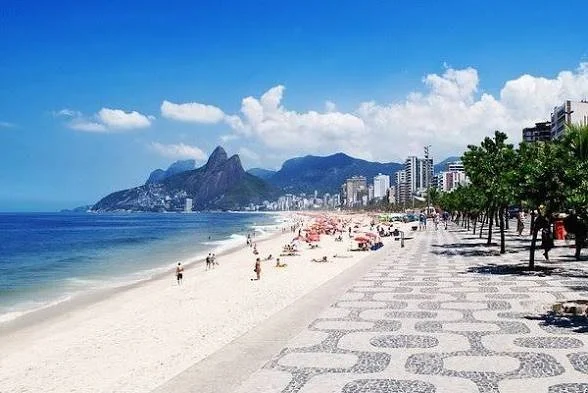
Scroll through social media for five minutes, and you’ll find her— or him, or them. Bronzed skin. A caipirinha sweating in one hand. The curve of Copacabana stretched behind them like a movie backdrop. The caption reads something like, "Living my best life in Rio! 🇧🇷❤️” And the comments pour in: “How do you DO it?” “You’re so brave!” “I’m moving there next year!”
What they don’t see: the influencer has been in Rio for six weeks. They’re on a tourist visa. They’re staying in a short-term Airbnb rental in Santa Teresa or Leblon—neighborhoods that were curated by tourism platforms specifically for people who want to experience Rio without actually having to live in it. They don’t speak Portuguese beyond “obrigado” and “um suco de laranja, por favor.” And they are telling you, with absolute confidence, what it’s like to call this city home.
They cannot. And we must call out the damage this mythology is causing — to the city’s image, its residents, and honest cultural discourse.
The Visa Is Telling You Everything You Need to Know
Brazil’s tourist visa grants visitors up to 90 days in the country, renewable for an additional 90 days within a 12-month period. That’s a vacation, extended. It is not residency. It is not immigration. It does not give you the right to work legally, to open a Brazilian bank account easily, or to access the social systems that structure daily life for the millions of people who actually live there.
Real residents navigate the CPF—Brazil's individual taxpayer registry—a bureaucratic process that is anything but simple for those not born there. They pay IPTU, the urban property tax. They deal with Detran, Brazil’s notoriously complex vehicle and document agency. They wait in line at Caixa Econômica Federal. They interact with a healthcare system that, outside the private sector, is buckling under years of underfunding, leading to long wait times and limited access to essential services for residents and immigrants alike. They navigate all of this in Portuguese, following Brazilian bureaucratic logic and adhering to Brazilian law.
A tourist visa holder in a furnished Airbnb in Ipanema experiences precisely none of these challenges. Their experience is curated by the hospitality industry, insulated by a favorable exchange rate—particularly for dollar and euro earners—and cushioned by the fact that if anything goes seriously wrong, they can get on a plane home. That option does not exist for the 6.7 million people who live in Rio de Janeiro.
The Airbnb Bubble and the City It Erases
There is a Rio that exists for short-term renters and digital nomads. It is stunning. Genuinely. The views from the Mirante Dona Marta at sunset are not a lie. The beach culture is real. The food is extraordinary. The music, the spirit, the warmth of the people you encounter in curated tourist spaces — none of that is fabricated.
But it is one layer. And it is the thinnest layer.
What the Airbnb economy has enabled, particularly in neighborhoods like Santa Teresa, Flímengo, Botafogo, and parts of Zona Sul, is the creation of a city within the city— a parallel Rio engineered for consumption rather than habitation. Short-term rentals have driven up housing costs for actual residents. Longtime Cariocas — native Rio residents — have been pushed out of neighborhoods their families occupied for generations, replaced by rotating casts of digital nomads posting content about how “authentically local” their experience feels.
The influencer rarely films in the Zona Norte. You won’t see Madureira, Penha, or Irajá—communities with deep Afro-Brazilian cultural roots, neighborhoods where Rio’s Black identity lives and breathes and fights for its survival. You won’t see the commuters packed into the BRT on a Tuesday morning at 6 a.m., or the families in Complexo da Maré navigating what it means to live in one of the largest favela complexes in Latin America. You won’t see what it looks like to be a working-class Carioca in a city that increasingly doesn’t seem built for working-class Cariocas.
Those stories fail to attract attention. Those stories require language, context, trust, and time. They require a relationship with the city that a tourist visa and a 90-day stay fundamentally cannot build.
Language Is Not Optional. It Is the Key.
This cannot be overstated: you cannot understand Rio de Janeiro without Portuguese. Not tourist Portuguese. Not Duolingo Portuguese. Actual, functional, street-level, Carioca Portuguese—the kind spoken fast and clipped, with slang that shifts by neighborhood and generation.
Language is how you know when someone is warning you. It’s how you hear in real time whether a neighborhood has shifted, whether there’s tension in the air, or whether the people around you are uneasy. Spoken Portuguese almost entirely communicates the signals that ensure your safety in Rio. Influencers who lack that fluency are not just culturally limited — they are operating without a critical safety layer, and they are modeling that blindness to hundreds of thousands of followers considering a visit or a move.
Language is also how you build trust. It’s how you access stories that aren’t told in English. It’s the difference between being photographed at Carnaval and actually understanding what the blocos you’re dancing in mean to the communities that created them. Without Portuguese, a visitor can consume Rio’s culture. They cannot participate in it. And they absolutely cannot speak about it with any authority.
The irony is that Rio’s most culturally and historically significant content — the history of samba, the roots of maracatu, the legacy of quilombola resistance embedded in the landscape itself — is locked behind a language barrier that most influencers in the city haven’t bothered to breach. So they film the sunset from the same overlooks, visit the same tourist-facing restaurants, and call it immersion.
The Hardships They’re Not Showing You
Life in Rio for its actual residents is not an aesthetic. It is complex, contradictory, extraordinarily beautiful in places, and genuinely dangerous in others—often within the same hour, the same square mile.
Dengue fever is not a travel advisory footnote—it is a seasonal epidemic that overwhelms the public health system and kills people. Stray voltage from poorly maintained electrical infrastructure remains a documented hazard on city streets and beaches. Police violence in communities like Jacarezinho has been the subject of international human rights reporting, not just a distant news story. Power outages, public transit disruptions, and the economic precarity of informal labor markets shape daily life for a significant portion of Rio’s population in ways that no Airbnb guest is equipped to document.
None of these things make Rio less worthy of love or coverage. They make it more complex and more worthy of honest reporting. A city is not a backdrop. Its people are not props. And a narrative that reduces Rio to golden hour on Ipanema beach, açaí bowls, and bossa nova playlists is not content — it is a disservice.
The Racial Erasure Hidden in the Fantasy
Rio de Janeiro has one of the largest Afro-Brazilian populations in the country. The city’s culture—its music, its food, its spiritual traditions, its language, and its very identity—was built on a foundation of African heritage from the enslaved people brought to Brazil through the port of Rio across nearly 300 years of the transatlantic slave trade.
When influencers curate their Rio content primarily through the lens of upscale beach neighborhoods and boutique experiences, they are often, whether consciously or not, presenting a whitewashed Rio. The Black residents who are the cultural architects of this city appear, if at all, as background figures in someone else’s story—a capoeira demonstration, a drumline at Carnaval, or a shot of a woman in a baiána costume that ends up as a thumbnail. Their communities, their struggles, and their extraordinary creativity and cultural production are left out of the frame.
This is not a peripheral critique. It is central to understanding what is wrong with the influencer economy’s version of Rio. The city being sold online is largely a Rio that has been gentrified, digitally and literally, with its Blackest and most historically significant neighborhoods rendered invisible.
What Responsible Coverage Actually Looks Like
There is nothing inherently wrong with loving Rio. There is nothing wrong with documenting a beautiful trip, sharing the food, the music, and the landscape. Rio deserves to be celebrated.
But there is a meaningful difference between saying “Here is what I experienced as a visitor” and “Here is what it’s like to live here.” The first is a travelogue. The second makes a claim about a place and its people that requires knowledge, humility, language, time, and an honest confrontation with everything the algorithm rewards you for leaving out.
If you want to tell Rio’s story with integrity, learn Portuguese — really learn it. Go to the Zona Norte. Spend time in communities that didn’t make Airbnb’s list of top picks. Talk to the historians, the activists, the mães de santo, the samba composers, the teachers, and the residents of complexes that have been under militarized occupation. Learn what your presence, your Airbnb booking, and your tourist spend are actually doing to housing prices and community displacement. Read the Brazilian press. Read the Black Brazilian press, especially.
And then, humbly, tell the truth about where you stand in relation to all of it.
Rio Doesn’t Owe You a Fantasy
There is a city in Brazil called Rio de Janeiro. It is one of the most remarkable places on earth. It is also a city of profound inequality, of staggering beauty existing blocks from desperate poverty, of a Black population that has been fighting for dignity and recognition for centuries, of a Carioca spirit that persists not because life is easy but because it endures although it isn’t.
That city will not fit in a reel. It cannot be captured in a photograph taken from a rooftop pool. It will not be understood through a translation app and a 60-day Airbnb stay.
The next time you see an influencer declaring themselves a Rio local from their seafront apartment, ask the question their captions never answer: Do they speak Portuguese? Do they know the name of the favela they can see from their balcony? Do they know its history? Have they ever needed anything that couldn’t be solved with a credit card and a wi-fi connection?
If the answer is no, they aren’t living in Rio. They’re renting a performance of it. And you deserve to know the difference.