Normal
by Kathia Woods
Bob Odenkirk's everyman action star evolution reaches a sweet, bloody, and thoroughly enjoyable peak in Ben Wheatley's snow-dusted neo-Western — even if the first half makes you wait for it.
There is something deeply right about seeing Normal exactly the way SXSW presented it — projected on 35mm film at Austin's Paramount Theatre, grain crackling, the image carrying that warm, analog weight that digital can approximate but never quite replicate. Ben Wheatley's neo-Western is, at its core, a movie about texture: the texture of small-town Midwestern life, of bundled-up politeness concealing violence, of an ordinary man forced by circumstance into extraordinary carnage. Seeing it on film, in a packed house already primed to cheer, was the right experience for the right movie. The question is whether the movie itself is worthy of all that ceremony — and the answer, while not unqualified, is a satisfying yes.
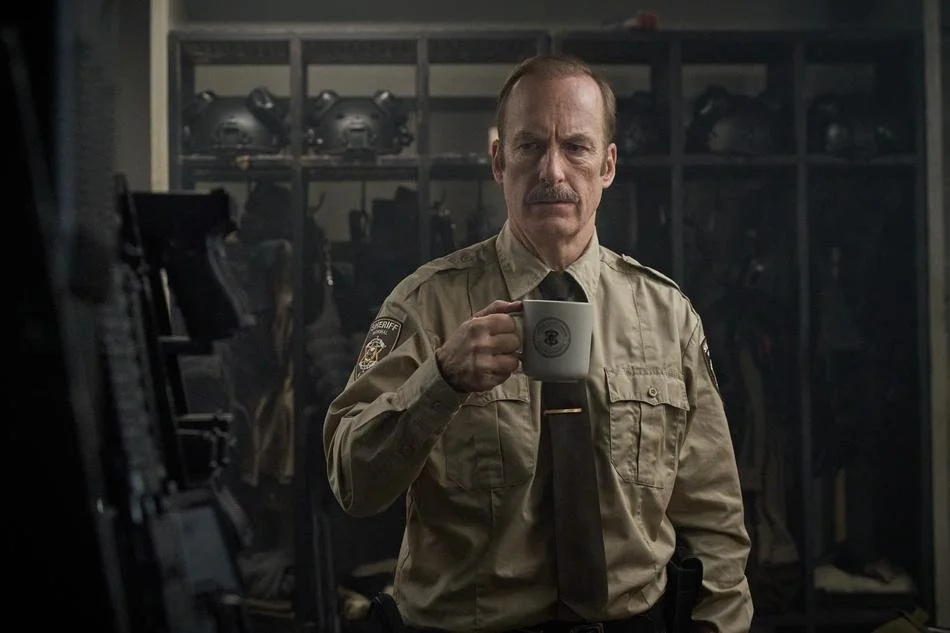
Bob Odenkirk plays Ulysses, an interim sheriff dispatched to Normal, Minnesota — population just shy of 2,000, snowpack permanent, hospitality reflexive — following the unexpected death of the town's previous lawman. Ulysses is not a crusader. He is, in fact, famous for de-escalating. Mayor Kibner (a wonderfully genial Henry Winkler) practically beams when he shakes Ulysses' hand: here is a man who will keep the lid on. Which is, of course, exactly when a botched bank robbery unravels the town's facade entirely and reveals a criminal underground with international tentacles — including, yes, the Yakuza — wrapped around the roots of this quintessentially American nowhere.
A note on the 35mm presentationWheatley and DP Armando Salas, ASC shot Normal digitally — on a RED Raptor XL[X] — but built their look around a specific reference: an edgy version of High Noon shot in the 1970s during a blizzard. Deep shadows, sharp contrast, visible grain embedded in the LUT. Screening the film on 35mm at the Paramount didn't contradict that vision — it completed it. The grain on the print and the grain in the image spoke the same language. It was one of those festival moments that reminded you why theatrical still matters. If you can catch this one in a theater when it opens April 17, do.
Here's the honest truth, though: Normal asks you to pay a patience tax, and it is steeper than it should be. The first half — roughly 45 of its lean 90 minutes — is setup. Setup that is gentle, quirky, and often charming, but setup nonetheless. Ulysses meets the townspeople. He navigates a community that is performatively wholesome while clearly concealing something. Wheatley, who in films like Kill List and Free Fire has shown a genius for building pressure before releasing it, is doing that here — but the release takes a while to arrive, and the escalation in between isn't quite funny enough to be a comedy or tense enough to be a thriller. It occupies an in-between space that is pleasant but not propulsive.
Odenkirk, to his great credit, holds the screen throughout. He has developed into a genuinely compelling action-adjacent presence — not because he seems dangerous, but precisely because he doesn't. His Ulysses is the kind of man who would rather talk someone down than confront them, who communicates through mild apology and meaningful pauses. Odenkirk has the rare ability to make passivity feel active, to make patience feel like its own kind of strength. It's a quality that made Saul Goodman one of television's great characters, and it makes Ulysses immediately sympathetic even when the film around him is coasting.
"Once Normal kicks into gear, it transforms into exactly the kind of theatrical experience you want to have with a full crowd — loud, propulsive, wickedly funny, and deeply satisfying."
And then the back half arrives. And Normal transforms.
Derek Kolstad — who built the architecture of the John Wick universe and scripted Nobody — has a gift for environment-as-weapon, and the second act of Normal is a masterclass in it. Everything the film has quietly laid in during its slow-burn first half becomes a Chekhov's Gun that fires, often hilariously and always violently, in the siege sequence that consumes the final stretch of the movie. A sleepy Minnesota town becomes a war zone, and the comedy of manners curdles into bloody, gleeful mayhem. Characters meet their ends in ways that will make you flinch and then immediately laugh at yourself for flinching. Wheatley, who also made the body-count carnival Abigail, understands that the best action comedy deaths don't announce themselves — they arrive sideways.
The ensemble does excellent work once the action gives them room to breathe. Lena Headey brings a watchful, steely intelligence to her role as Moira that hints at depths the screenplay doesn't fully excavate — she's the kind of supporting performance that makes you wish the movie were longer, which is the rarest kind of complaint. Winkler's Mayor Kibner is delightful precisely because you're never entirely sure which side of Normal's particular moral ledger he falls on. And Billy MacLellan, as Deputy Mike Nelson, earns genuine affection in the film's quieter character moments.
What's most interesting about Normal as a piece of filmmaking is watching Wheatley — an English director whose work has careened from psychedelic horror (A Field in England) to anarchic action (Free Fire) to studio franchise obligations (Meg 2) — navigate the iconography of American genre film. The Midwest, in American cinema, has its own grammar: the flat open space, the bundled-up toughness, the dark secrets beneath cheerful surfaces. Fargo wrote the definitive grammar guide. Normal doesn't reach those heights, but it knows the language. Wheatley uses the snow as an active participant, not just a backdrop — it muffles, isolates, and eventually becomes part of the chaos in ways that feel both intentional and delightful.
The film's visual approach, as noted in DP Armando Salas's own production notes, was built around an analogue aesthetic: deep shadows, a film-emulation grade, lenses chosen for their softness rather than clinical precision. On 35mm at the Paramount, this intention sang. In a multiplex on digital, some of that soul may be harder to feel — but the bones of the filmmaking are strong enough that the movie will hold regardless.
Normal is a film of two very distinct halves that together add up to something genuinely worth your time. The first half tests your patience; the second half rewards it spectacularly. Bob Odenkirk continues to be one of the most compelling unlikely action stars working today — not because he's convincing as a killer, but because he's convincing as a fundamentally decent man who keeps getting caught in situations that require him to become one. Ben Wheatley brings his gonzo sensibility to Americana with real affection, and the result, for all its unevenness, is the kind of crowd-pleasing genre movie that the theatrical experience was built for. Catch it the way it was meant to be seen — in a room full of people who have no idea what's about to hit them.