Beyond the Beach and the Favela: Why African Americans Keep Missing Black Rio
The Black experience in Rio de Janeiro is vast, layered, and thriving — but you won't find it from a Zona Sul hotel balcony or on a favela tour. It's time for the diaspora to go deeper
There is a particular ritual that plays out whenever African Americans visit Rio de Janeiro. They book hotels in Ipanema or Copacabana, snap photos at the Christ the Redeemer statue, take a guided tour of a favela deemed safe enough for outsiders, and return home convinced they have seen Black Brazil. They post on social media about poverty, resilience, and rhythm. They speak with authority about a city they have largely skimmed from the edges. And in doing so, they miss Rio almost entirely.
This is not a criticism born of condescension. It is a challenge born of love—love for a city whose black soul runs deeper than any beach and is richer than any postcard— and a genuine frustration with the narrow lens through which so many in the African American diaspora choose to see it. Rio de Janeiro is not simply beautiful and tragic. It is also brilliant, professional, organized, culturally sovereign, and unmistakably, powerfully Black—in ways that the standard tourist itinerary was never designed to reveal.
African Americans who visit Rio but do not venture into Zona Norte miss experiencing Black Rio. They have only experienced the concept of Black Rio.
The Zona Sul Trap
Zona Sul — the southern zone that encompasses Copacabana, Ipanema, Leblon, and Barra da Tijuca — is Rio's glamour district. It is where international tourists cluster, where luxury hotels dominate the skyline, and where the infamous beaches draw millions of visitors every year. It is also, as scholar Patricia de Santana Pinho observes in Mapping Diaspora: African American Roots Tourism in Brazil, a geography that was not built to showcase the lives of Black Brazilians. "It is unlikely that American tourists will spot many Afro-Brazilians during their stay on Rio's hottest beaches," she notes—a quiet but devastating truth about who is and isn't visible in the city's most marketable spaces.
The African American traveler who lands in Zona Sul and takes the whole of Rio from there is engaging in a kind of selective tourism that, however unintentional, mirrors the colonial gaze: look at the landscape, admire the spectacle, and leave before anything complicated begins. Zona Sul is gorgeous. It is also curated. And the curation has not historically included a full accounting of Black life.
Brazil's tourism infrastructure—shaped by decades of government promotion, travel industry incentives, and international media—has long packaged Rio as a city of beaches and Carnival floats, of Christ and caipirinha. What it has rarely led with is the profound, organized, politically conscious Black civilization that has been building itself in the city's north for over a century.
Favela Tourism Is Not the Answer
When African American visitors do venture beyond the beach, the destination is often the favela. And there is something seductive about this impulse—a sense of solidarity, of refusing to look away from poverty, of honoring struggle. But favela tourism, as currently practiced by most visitors, does not constitute engagement with the Black experience in Rio. It constitutes, more often than not, a transaction.
The favelas of Rio—hillside communities with roots in the quilombos formed by escaped African enslaved people—are not museums of Black suffering to be observed from a van window. Favelas are complex, vibrant neighborhoods where remarkable individuals have created incredible things despite facing significant challenges. But the moment a visitor steps into a favela for two hours and believes they have touched the soul of Black Brazil, they have confused proximity with understanding.
More critically, the automatic equation of Black Brazilian life with favela life—poverty, violence, and informality—reveals the very bias that African American visitors believe they have escaped. If you travel to Rio assuming that Black people live only in informal settlements, you are not practicing diaspora solidarity. You are practicing a form of social imagination that is itself a product of racism: the belief that Blackness, wherever it lives, must be indexed to deprivation.
"At first glance, it may appear unrefined." But once you encounter the people there, you realize that they are similar to Black people in the USA. Same vibe, same type of struggle, but they tend to be more unified around Black consciousness.""—Kurtis Henry, travel entrepreneur and frequent visitor to Rio de Janeiro
Henry's reflection about Madureira—not a favela, but a predominantly Black working- and middle-class neighborhood—is precisely the correction that most visitors never make. The assumption is always that Black life in Rio is there, in the hills, in difficulty. The market, the samba hall, and the boardroom are not the places where Black life exists.
Zona Norte: The Black Heart of Rio
Forty minutes away from Copacabana by public transit—a journey many tourists never make— lies a different Rio. Zona Norte, the northern zone, is home to the neighborhoods that have defined Afro-Brazilian urban culture for generations. It is where the rhythm was born, where the schools were built, and where the movement lives. And for most African American visitors, it remains entirely invisible.
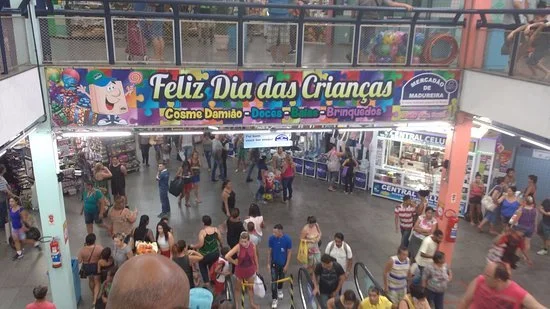
Madureira, the neighborhood that anchors much of Zona Norte's cultural identity, is a city unto itself. With roughly 70 percent of its residents claiming African descent, it is what many Cariocas—people native to Rio—call the Black Mecca of the city. Mercadão de Madureira draws tens of thousands of shoppers a week. Parque Madureira hosts community gatherings, live music, and open-air samba sessions that bear no resemblance to the sanitized spectacle sold to tourists at Carnival.
"I love Madureira so much. It's outside of the tourist area, and it has a high concentration of Afro-Brazilians. They have very unique parties every weekend that you can't find anywhere else in the city. I'd rather be there than in the south zone." — Kurtis Henry, Flight Life Group
Henry has been traveling to Brazil since 2014 and has seen both RIOs. His preference is clear. "Madureira reminds me of the USA in the 90s," he says. "Block parties, people are outside enjoying the day with friends, and it's a meeting point for a lot of the Black people from around the city on Friday, Saturday, and Sunday." This is not the Rio of postcards. It is the Rio of lived Black life—and it is what most visitors never see.
North of Madureira sits Pequena África—Little Africa—the historic port district that encompasses the neighborhoods of Saudade, Gamboa, and Santo Cristo. This is where enslaved Africans first arrived on Brazilian soil, where the quilombo of Pedra do Sal was established, and where open-air samba parties still draw locals on weekend nights. It is Rio's foundational Black geography, and it sits about fifteen minutes from Copacabana.
"Black tour guides with a Black journalist in a Black neighborhood in Rio? It's not normal, but it's special." — Lua Ferreira, Afro-Brazilian cultural tour guide
Ferreira's comment—made to a journalist during a tour of Pequena África—speaks volumes about what visitors to Rio actually seek out and what they do not. She spent years working for mainstream tourist companies before launching her own operation focused on Brazil's Black history. "Brazil has ignored Black people for so long," she has said. "But finally, girls like her can see themselves in this city." If African American visitors never visit the location where this story unfolds, they will miss out on hearing it.
The Samba Schools Are Not Tourist Attractions. They are archives.
Of all the cultural institutions that African American visitors overlook in Rio, perhaps none are more consequential than the samba schools—the escolas de samba that anchor the cultural life of Zona Norte. Visitors who attend Carnival at the Sambadrome may think they have encountered the samba schools. They have not. They have attended a performance. The schools themselves are something else entirely.
Founded in the late 1920s by Black communities in neighborhoods like Estácio, Mangueira, and Oswaldo Cruz, the samba schools were acts of cultural resistance from their inception. They emerged as a direct challenge to the European-inflected marchinhas that dominated Carnival, rooting the celebration instead in rhythms of Bantu African origin. They were, from the beginning, the Black community's insistence on its own legitimacy—its own memory, beauty, and narrative authority.
Mangueira, founded in 1929 in the hill community of the same name in Zona Norte, has become perhaps the most celebrated exemplar of samba as political art. In 2019, the school won the Carnival championship with a production titled História Para Ninar Gente Grande—roughly, History to Lull Grown-Ups—that confronted Brazil's erasure of its Black and indigenous heroes. The theme, developed as Jair Bolsonaro's far-right government took power, was a declaration of cultural sovereignty.
"It's an alternative version of history. Brazil's history has turned into a soccer match, in which we have learned to support the winner. We forget, however, that we are the ones who have lost." — Leandro Vieira, Mangueira artistic director
This is not entertainment. This is archival practice—the keeping and transmission of memory through the only institutions that were never fully closed to Black Brazilians. The samba schools in Zona Norte operate year-round, not only during Carnival. Portela, the centenarian school from Oswaldo Cruz and Madureira, has been running literary festivals since 2019, hosting Black writers, historians, and community leaders at events that bring thousands of residents into contact with Afro-Brazilian literature and history.
"Learning takes place through orality and life experiences, and knowledge circulates accordingly." — Mauro Sérgio Faria, Portela Cultural Department
When an African American tourist visits Rio and never enters a samba school—never attends a Saturday night rehearsal in Mangueira or Portela, never sits in those stands surrounded by Black Brazilians singing about their own history—they have left the library without opening a single book.
The Black Middle Class You Were Told Doesn't Exist
Perhaps the most persistent and damaging myth that African American visitors carry to Rio is the belief that there is no Black Brazilian middle class—that Blackness in Brazil exists only in poverty, in the hills, in spiritual practice divorced from economic life. This myth is not only wrong. It is harmful.
Brazil's affirmative action policies, implemented across public universities beginning in the early 2000s, have produced a generation of Afro-Brazilian professionals whose existence directly contradicts the narrative of absolute exclusion. As researchers at Harvard's ReVista journal have documented, graduates of these programs are "becoming doctors, engineers, and lawyers — professions almost exclusively occupied by white people in the not-so-distant past." The transformation is incomplete, and the struggle against structural racism remains urgent. But the Black professional class is not invisible — it is simply not where tourists look.
Academic research by Reighan Gillam, examining Black-owned media in Brazil, found that Afro-Brazilian content creators actively worked to challenge "the idea that middle-class status whitens one's identification"—in other words, the racist assumption that when Black Brazilians achieve professional status, they somehow cease to be Black. The existence of a Black-owned television network, TV da Gente, that featured shows ranging from talk shows to legal dramas centered on Black professionals, was not an aberration. It was a declaration: we are here, we have always been here, and our Blackness does not require poverty as its proof.
Black Brazilian professionals—architects, doctors, lawyers, academics, and entrepreneurs—navigate a society where racism is structural and persistent, where wage gaps are documented, and where discrimination in elite professional spaces is well-documented by researchers like Silva and Reis. However, they navigate this society as fully realized Black individuals, rather than as exceptions to the norms of Blackness. The African American visitor who assumes Brazil lacks a Black middle class does not see clearly. They are projecting the specific American template of racial visibility onto a country with its complex, contested, and evolving racial landscape.
Zona Norte is where much of that Black professional and middle-class life actually unfolds—in the shops and markets of Madureira, in the administrative offices of the samba schools, and in the churches and cultural organizations and community associations that have sustained Black life in Rio for generations. You will not find such places on a Zona Sul hotel concierge's recommendation list. You have to go looking for it.
What Real Diaspora Solidarity Looks Like
The African American relationship with Brazil has always been characterized by a sense of longing. As scholars of diaspora tourism have noted, African Americans travel to Brazil seeking similarity— wanting "to be among a Black majority" and to feel what was lost in the Middle Passage. This desire is real, and it is beautiful. But longing without curiosity produces a distorted image. You see what you need to see, rather than what is actually there.
Real diaspora solidarity with Black Rio does not begin on the beach. It begins on the bus to Madureira. It continues at the Saturday night rehearsal at a samba school in Zona Norte, where the drums are not performance but memory. It deepens at Pedra do Sal, the ancient quilombo rock in Little Africa, where samba was born and where, on weekend nights, you can still hear it happening without a ticket, without a tour guide, and without a safety briefing from a hotel concierge.
It means seeking out Black Brazilian professionals and asking them about their lives—not as curiosities but as peers. It means walking through Mercadão de Madureira as a customer, not a visitor. It means accepting that the Black experience in Rio de Janeiro is not a wound to be visited or a culture to be consumed. It is a civilization to engage in.
"I want to help build a new perspective around Brazilian international identity." — Lua Ferreira, a cultural tour guide and historian from Pequena África
Ferreira is right that perspective is the work. But the perspective has to be built on presence—real presence, in real places, among real people living real lives. That means Zona Norte. It means the samba schools on a Tuesday night in October, not just the Sambadrome in February. It means the Black neighborhoods that were never designed for tourists precisely because they were designed for Black people.
Rio de Janeiro is a city with more than six million people, a history that stretches back to 1565, and a Black population that has been building—surviving, resisting, creating, and thriving—since the first African arrived on its shores. The city does not owe African American visitors a legible version of itself. But if we are serious about the diaspora, if we believe that the connections forged across the Atlantic are worth more than Instagram content, then we owe Rio more than a beach chair and a favela tour.
The next time you go, go north. Go all the way.