Butterfly Jam — A Film That Can't Quite Spread Its Wings
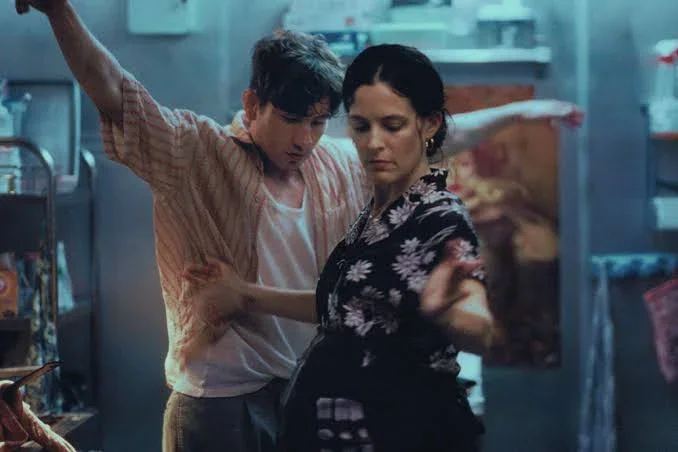
There’s a moment early in Butterfly Jam when Barry Keoghan’s Azik a widowed Circassian line cook running a struggling diner on the drab fringes of Newark, New Jersey—serves his friends a preserve made from actual butterflies. It’s strange, poetic, and oddly beautiful. It’s also the clearest distillation of everything director Kantemir Balagov is attempting with his long-awaited English-language debut: something sweet conjured from the most unlikely of ingredients. The trouble is, the film never quite figures out what it wants to be once it’s done showing you the jar.
Opening this year’s Directors’ Fortnight at Cannes, Butterfly Jam tracks one of the festival’s most familiar archetypes—the distinctly ethnic tri-state dirtbag, a lineage that runs through Safdie, Scorsese, Baker, and Gray. But Balagov’s version carries the additional weight of displacement: originally conceived to be set in Russia, the film was retooled after Balagov was forced into exile following his condemnation of Putin’s war on Ukraine, with the story relocated around a real Karbadian community in New Jersey. The seams, unfortunately, show.
The film centers on teenage Temir (newcomer Talha Akdogan), a promising wrestler navigating the tension between his Circassian roots and his American present. His father Azik—played with that trademark rolling, feral physicality by Keoghan—rules the kitchen of their little-frequented diner, taking immense pride in his traditional delen pies while proving far less reliable in every other department of fatherhood. Keough brings a poignant, palpably exhausted stillness to Zalya, Azik’s older sister, who shoulders the business with quiet thanklessness while her brother courts chaos, particularly in the combustible company of his friend Marat, played by Harry Melling.
The performances are not the problem. Keoghan is, as ever, magnetically watchable, his strange energy commanding the screen even when the script gives him precious little scaffolding to work with. His strange, rolling physicality and scratchy delivery continue to be magnetic, a suitable counter-energy to Keough’s stillness. You find yourself watching him in quiet scenes, waiting for him to detonate, which is both a credit to his craft and an indictment of a narrative that keeps stalling. The uber-talented Irishman deserves material that can keep pace with what he brings to a frame.
The film never quite coheres as either a father-son drama or a saga of displacement; instead, it plays more like a jagged character study of a profoundly eccentric man. Balagov layers in eccentricities—a man who keeps pelicans as pets, a teenage girl who describes the sensation of brushing someone’s hair as a spiritual act—but the accumulation of quirk doesn’t substitute for dramatic momentum. By the third act, when the narrative finally attempts to land a significant emotional blow, the effect is galvanizing without being wholly convincing, cueing a denouement that lurches uncertainly between melodrama and outright whimsy.
What saves Butterfly Jam from being a complete disappointment is what’s happening behind the camera. Cinematographer Jomo Fray—who brought such bruising intimacy to Nickel Boys—plays dusky underlighting against a candied palette of oranges and pinks, all faintly, fittingly spoiled and on the turn. The score by Evgueni and Sacha Galperine keeps you on edge. And Balagov’s formal instincts do occasionally produce something genuinely transcendent: one bravura scene has Azik and Temir body-slamming a streetful of cars to trigger their alarms, the resulting symphonic cacophony of light and sound becoming their own protest against a quiet, overlooked life.
But gorgeous moments do not a cohesive film make. Butterfly Jam is beautiful to look at, intermittently compelling to watch, and ultimately running in circles—a story about rootless people that itself never finds solid ground. Balagov’s promise, so evident in Beanpole, remains intact. The film, however, needs a stronger center. Much like its butterfly jam, it’s a curiosity—fascinating in concept, harder to digest as a full meal.