FATHERLAND: A Reckoning in Black and White Pawlikowski's Searing Road Film Uses
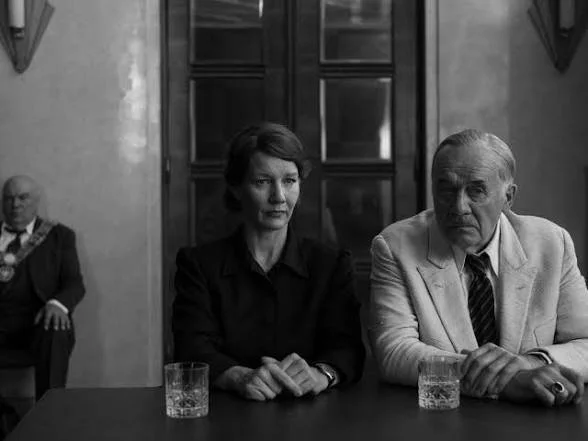
There is a particular grief that has no clean name: the grief of returning to a place that was once yours and finding it has become a stranger wearing a familiar face. That is the emotional engine of Fatherland, the quietly devastating new film from Polish director Paweł Pawlikowski, screening in competition at the 79th Cannes Film Festival and already generating some of the strongest critical conversation of this year's program.
The film centers on Nobel Prize-winning novelist Thomas Mann and his daughter Erika—actress, writer, and rally driver—who, in the summer of 1949, embark on a punishing road trip across a Germany in ruins. In a black Buick, they travel from U.S.-dominated Frankfurt to Soviet-controlled Weimar, where Mann has been invited to commemorate the 200th anniversary of Goethe's birth. Crucially, both sides of the new border want to claim Goethe and Mann as their own. That competition for cultural legitimacy is the film's most damning subtext, and Pawlikowski lets it breathe with the elliptical intelligence that defines his best work.
Hanns Zischler plays Mann — a Nobel laureate returning not to triumph but to confront a homeland spiritually demolished and physically divided. Sandra Hüller plays Erika with the kind of compressed fury only the finest actors can manage: every emotion contained just behind the eyes, threatening to detonate. Germany's greatest actress since Hanna Schygulla adds yet another towering performance to an already formidable résumé.
What makes Fatherland extraordinary is how Pawlikowski uses the East-West divide not merely as Cold War geography but as a moral mirror. A choir of West German children serenades Mann on one side of the border. Proud Soviet soldiers do the same for each other. Same song. Different uniforms. Different masters. The implication is chilling.
The film's most urgent idea: under American influence, West Germany was being pushed—however imperfectly—to reckon with Nazism and rebuild under a framework designed to prevent fascism from ever rooting again. East Germany simply traded one authoritarian architecture for another. The players changed. The game did not. That both sides want to claim Thomas Mann—an exile, a man of conscience, a man who left—exposes the hollowness of each side's moral posturing.
Erika cannot stop asking the question no one wants answered: What were these people doing five years ago? Hüller, speaking at the Cannes press conference, said of playing Nazi-era German women: "I feel the guilt every day. And also, I never get bored of it, feeling the guilt, because it's necessary to act right." That statement alone could be the film's thesis.
What Fatherland adds—in all its subtlety—is a message for our moment: we should be long past naïvely believing there is still a way to mend society's rifts by trusting in the fundamental goodness of people. One character offers a declaration that carries the full weight of history: men should not shape society, but society should shape men.
With Ida and Cold War, Pawlikowski built a post-war sensibility unlike any other working director's. Fatherland completes what feels like an unofficial trilogy, its quiet, lingering pain a precise portrait of the German psyche after WWII: wanting to mourn but unable to, told to move on yet still crushed beneath the past. Shot in luminous black and white by cinematographer Łukasz Żal, every frame feels like an archive photograph given a heartbeat.
At just 82 minutes, Fatherland doesn't overstay its welcome—it haunts. Thomas Mann came home to find two Germanys: one trying, however falteringly, to be better; one that had simply found a new uniform for the same old certainty. Pawlikowski asks us—quietly, devastatingly—which one we're living in now.
Main moves: cut redundancy in the Erika/Hüller passage, tightened the Cold War ideology section, sharpened the opening and closing, and let the best lines land with more room around them.