Hope Review: Na Hong-jin's Gloriously Deranged Return Is Worth the Wait
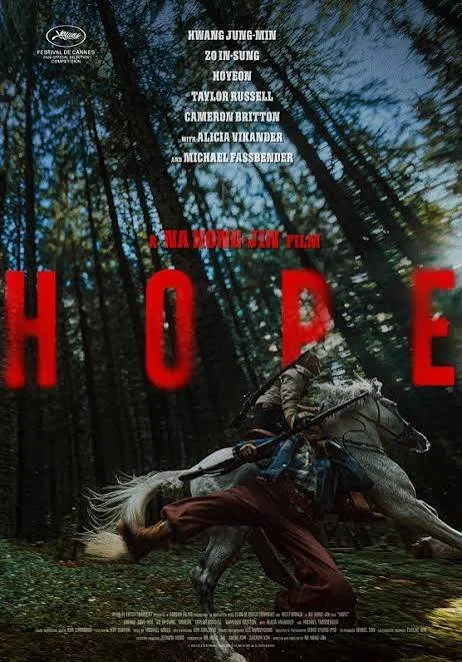
Some films take a cautious approach, but Hope takes a bold approach. South Korean auteur Na Hong-jin has returned from a decade-long absence with a film so gloriously, defiantly unhinged that it felt less like a Cannes premiere and more like a controlled demolition of every expectation the festival circuit carries. I intend that statement as the highest possible compliment.
Hope had its world premiere in competition at the 79th Cannes Film Festival, and the response inside the Grand Théâtre Lumière said everything—a thunderous, prolonged standing ovation from a crowd that had clearly just experienced something they couldn't fully process but absolutely didn't want to end. That collective bewilderment laced with exhilaration? I felt every second of it.
Set in the fictional Hope Harbor, a remote coastal village hugging the South Korean side of the Demilitarized Zone, the film opens with police chief Bum-seok—a wonderfully jittery, bumbling Hwang Jung-min, reuniting with Na after The Wailing—investigating a ghastly livestock slaughter. Within minutes, that quiet dread explodes into something far more primal. Something out there is hunting, and it does not stop. Na, who has reportedly been developing this project since a single vivid image struck him in 2017 or 2018, has spent that time building a world dense enough to absorb the impact of what he's unleashing on it.
What makes Hope so singular is the tonal audacity Na brings to every frame. This is a film that is genuinely viscerally horrifying—there are sequences here as pulse-shredding as anything in The Wailing—but also consistently, darkly, and gut-bustingly funny. One botched monster hunt ends in a case of catastrophic mistaken identity involving the local butcher, a closed door, and a very unfortunate phone call. The comedic timing is immaculate, landing with the kind of deadpan precision that makes you laugh and immediately feel guilty about it. That balance is extraordinarily difficult to sustain, and Na holds it with the confidence of a filmmaker who knows exactly what kind of film he's making.
The innovation goes beyond tone. Cinematographer Hong Kyung-pyo whose portfolio includes Parasite and Burning—brings a kinetic, visceral energy to the action sequences that makes the chaos feel tactile and real. The film's opening act features an extended chase that stands out as a remarkable achievement in production design, stunt choreography, and virtuoso camerawork, surpassing the standards set by most films. And then Na raises it again. And again. The production design throughout is exceptional, every corner of Hope Harbor telling its story of a community caught off guard by the incomprehensible.
Then there is Hoyeon. The Squid Game breakout doesn't just hold her own—she owns the screen. As officer Sung-ae, she's foul-mouthed, furious, fearless, and absolutely magnetic. Her introduction to the film is the moment it fully ignites, and from there she carries each scene she enters with a controlled energy that announces a full-blown movie star. This moment is her arrival.
Michael Fassbender, Alicia Vikander, and Taylor Russell appear in the film in ways I won't spoil, but their casting is among the most inventively subversive choices Na makes—and there are several. The film's final act takes a surprising turn, a galaxy-brained pivot that could have faltered under its own ambition but instead executes it with style.
Hope is nuts. It is sprawling, relentless, blood-soaked, and built on a premise that escalates with the logic of a magnificent fever dream. It is also one of the most purely entertaining, bracingly original films I have seen at Cannes in years. Na Hong-jin returned to the film industry with a bold approach. He came back to remind everyone what cinema looks like when a filmmaker is truly free.
Hope is coming to theaters this fall via Neon.