Between the Cross and the Crossroads: Marie Madeleine Is a Reckoning
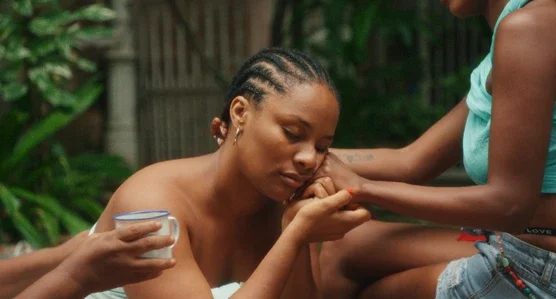
There are films that entertain, films that challenge, and then there are films that reach inside you and rearrange something. Haitian filmmaker and actress Gessica Généus does the latter with Marie Madeleine, a stunning, spiritually restless drama that premiered in the Cannes Première section of the 79th Festival de Cannes. Set in the coastal town of Jacmel on Haiti's southern shore, the film is many things at once—a love story, a political indictment, and a meditation on faith, desire, and freedom—but above all, it is a portrait of two lost souls who find in each other not romance, but recognition.
In Jacmel, the sea, the churches, and the spirits shape daily life. This is not mere poetic staging. It is a declaration. Généus — who also stars as the title character — plants her film squarely at the intersection of Haitian Vodou and European Christianity, and she refuses to resolve the tension between them. That refusal is the point.
Marie Madeleine is a sex worker; Joseph is the preacher's son. His father is opening a church directly across the street from Marie's brothel—a geographical landmine that leads to explosive confrontations between the highly religious parishioners and these carefree women. It's an almost theatrical arrangement, but Généus earns it. The church and the brothel aren't symbols so much as they are competing inheritances—one imposed, one survived. The Christianity that Joseph's father preaches is the Christianity of the colonizer, imported to Haiti as a tool of erasure. The world Marie inhabits, fragrant with Vodou tradition and African spiritual memory, is the inheritance that colonization tried to bury.
That burial is the film's deepest wound. Haiti was colonized by France, and with colonization came the theological contract: adopt the Church and abandon the spirits. Haitian people, forced to conform or face violence, did what the colonized have always done—they adapted, they concealed, and they survived. Vodou went underground, masked behind Catholic saints, hiding in the very iconography of the oppressor. Marie Madeleine refuses that concealment. Généus lets the Vodou breathe, lets it move, and lets it be ancestral and beautiful and alive. Généus develops rapturous sequences that become seared into the spirit—a queer parade whose revelry turns into a swirling celebration. In these moments, African Haitian identity is not a footnote. It is the text.
Late night drum circles around a campfire, where the beat becomes irresistibly seductive, are where this film breathes its freest. They are also where Joseph comes undone in the best possible way. And that unraveling is where Marie Madeleine becomes something truly extraordinary.
Joseph is a man carrying more secrets than his Bible has pages. He is a son starved of his father's love and approval—a young man who has tried to build a self out of devotion, out of service, out of keeping his camera between himself and the world. Joseph needs to put a camera between himself and reality. He protects himself from others and, most of all, from himself. His lens is not an artistic tool so much as a survival mechanism—a way of witnessing life without having to live it, of experiencing desire without having to name it.
Forced to hide his homosexuality under the gaze of his community, Joseph becomes the silent reflection of another kind of marginality. Here, Généus performs something almost miraculous: she braids together three oppressions — colonization, religious fundamentalism, and sexual repression — and shows how they are not separate crises but the same wound, reopened in different bodies. The Church that robbed Haiti of its African roots is the same institution demanding Joseph deny his own. His father's god has no room for the Vodou spirits of his ancestors and no room for the man his son actually is. Joseph is caught in the suffocating double bind of a people conditioned to hide everything that is truly theirs.
What Généus understands, brilliantly, is that Marie Madeleine doesn't save Joseph by offering him romance. She saves him by offering him space. Marie Madeleine transforms herself into more of a protective mother to Joseph than a lover—the relationship between them is one the director deliberately wanted to transcend the sexual. As Généus herself has said, "What matters to me is if there is space to explore who he wants to be." That philosophical clarity is what separates Marie Madeleine from lesser films that treat queerness as a plot and faith as an obstacle. Here, both are living, breathing things—complicated, worth fighting for, worth mourning.
Though Joseph holds God and the Bible in high regard, he doesn't condemn Marie. He cannot, because he recognizes in her the same experience of being someone the world has decided is unworthy of grace. Two people the church has cast out—one for what she does, one for who he is—are finding in each other a theology the institution never taught: that belonging can be chosen, that wholeness does not require permission.
And Marie herself is one of the most fully realized women I've seen on screen this year at the festival. She is not a savior figure, not a cautionary tale, not a metaphor for Haiti's suffering. She is a woman who lives loudly, defiantly, on her own terms. She is quick to clarify that she wasn't named after Mary Magdalene, but rather her grandmother, who had been lured to the island under false pretenses and abandoned—not only struggling to maintain a life for herself by any means necessary, but trying to dig herself out of a hole that future generations would have trouble climbing out of themselves. That lineage matters. Marie carries the weight of women who were never protected, never believed, and never given the option of respectability. Her freedom is not irresponsibility. It is a form of memory. A form of resistance.
The layout of Joseph's church is consciously structured and overly composed, while Marie's brothel is open and airy. Généus understands that visual grammar is political. Control belongs to the colonizer's religion. Liberation belongs to the African roots still pulsing beneath Jacmel's streets—and to the young man slowly learning that God might be larger than his father's house.
Marie Madeleine is not a perfect film — its opening rushes past tragedy too quickly to let certain wounds breathe. But its ambition is staggering, and its heart is true. This is cinema as spiritual excavation. As Généus herself has described it, "This film speaks to the search for truth in a world that forces us to lie." It is about a sex worker who never lied. A young man who is learning how to stop. And an island that has been forced to lie about who it is for centuries. Généus does not simply tell a story about Haiti. She tells the truth about what colonization does to a people's soul—and what it looks like when two broken, beautiful human beings refuse, at last, to stay buried.
Marie Madeleine screened in the Cannes Première section of the 79th Festival de Cannes.