He Had Every Reason to Stop Dreaming — He Didn't-Congo Boy
There are films that entertain, films that educate, and then there are films that demand to be felt in the marrow. Congo Boy, the debut narrative feature from Central African Republic director Rafiki Fariala, belongs firmly to that third category. Screened in the Un Certain Regard section of the 79th Cannes Film Festival, this 95-minute musical drama is one of the most quietly urgent films of the year—a story about a boy the world has tried to erase, who refuses to be erased.
Robert, 17, is barely holding on in Bangui, the capital of the Central African Republic. His parents are in prison, caught in the bureaucratic purgatory of being refugees. He has four young siblings to look after, his final school exams are looming, and somewhere beneath the weight of it all, he dreams of becoming a musician. It is a premise that could easily have collapsed into misery tourism, but Fariala—who, like Robert, lived this reality—refuses to let suffering be the whole story. He insists on humanity. He insists on joy. And in doing so, he has made something genuinely extraordinary.
The film draws its power from its refusal to sentimentalize. Fariala draws on his experiences as a Congolese refugee in Bangui, spinning personal history into a documentary-inflected realist drama. The result is cinema with skin in the game—not advocacy from a distance, but testimony from inside the wound. Dialogue flows across Lingala, Sango, Swahili, and French, a multilingual tapestry that itself tells a story about the complex, layered lives refugees navigate daily, code-switching not just in language but in identity and survival.
The film is clear-eyed about what conflict costs families like Robert's. The Congo crisis—one of the most devastating and underreported humanitarian disasters in the world—is not a backdrop here; it is the architecture of every scene. His parents' imprisonment stems from the desperate act of falsifying passports. Robert and his four siblings—Espérance, Aurélie, Jacqueline, and Daniel—live in a compound owned by a military colonel, itself a precarious arrangement as armed militias occupy the city. These are the impossible mathematics of displacement: every choice carries risk, and every safe space has a cost.
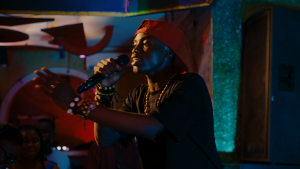
And yet, Robert dares to dream. That is where Bradley Fiomona Dembeasset enters the conversation, and he does not merely enter it; he seizes it. His portrayal of Robert is nothing short of a revelation. In between washing cars, selling water, and hesitantly buying sanitary towels for his younger sister, Robert writes lyrics that reflect his experiences—and Dembe Assset renders every one of those private moments with a vulnerability that feels unguarded and utterly real. He carries the film on his back without ever making it look like effort.
The final act crystallizes everything in his performance in his gestures, his words, and even the stage name he adopts, which affirms an identity he has been slowly stepping into throughout the film. In that moment, Robert is free, rebellious, and more alive than ever. The jury at Cannes saw it too. Dembeasset took home Best Actor honors from the Un Certain Regard jury, presided over by French actress Leïla Bekhti. The award was earned. In his acceptance speech, delivered in song, he closed with a declaration that shook the Debussy screening room: "I am a young Congolese! I am a refugee! I am a star!" It was a moment that belonged entirely to him and to every young person the world has tried to render invisible.
The supporting cast matches his energy beautifully, with the young performers playing Robert's siblings bringing an unpolished naturalism that enriches every family scene. Fariala entrusted roles to local non-professional actors whose authenticity is often striking on screen, a choice that roots the film in community rather than performance.
Congo Boy is the kind of debut that announces not just a director but a worldview. Fariala has made a film that earns its warmth not by looking away from pain, but by finding, at the center of extraordinary hardship, an extraordinary young man who still believed music could save him. It just might save us, too.