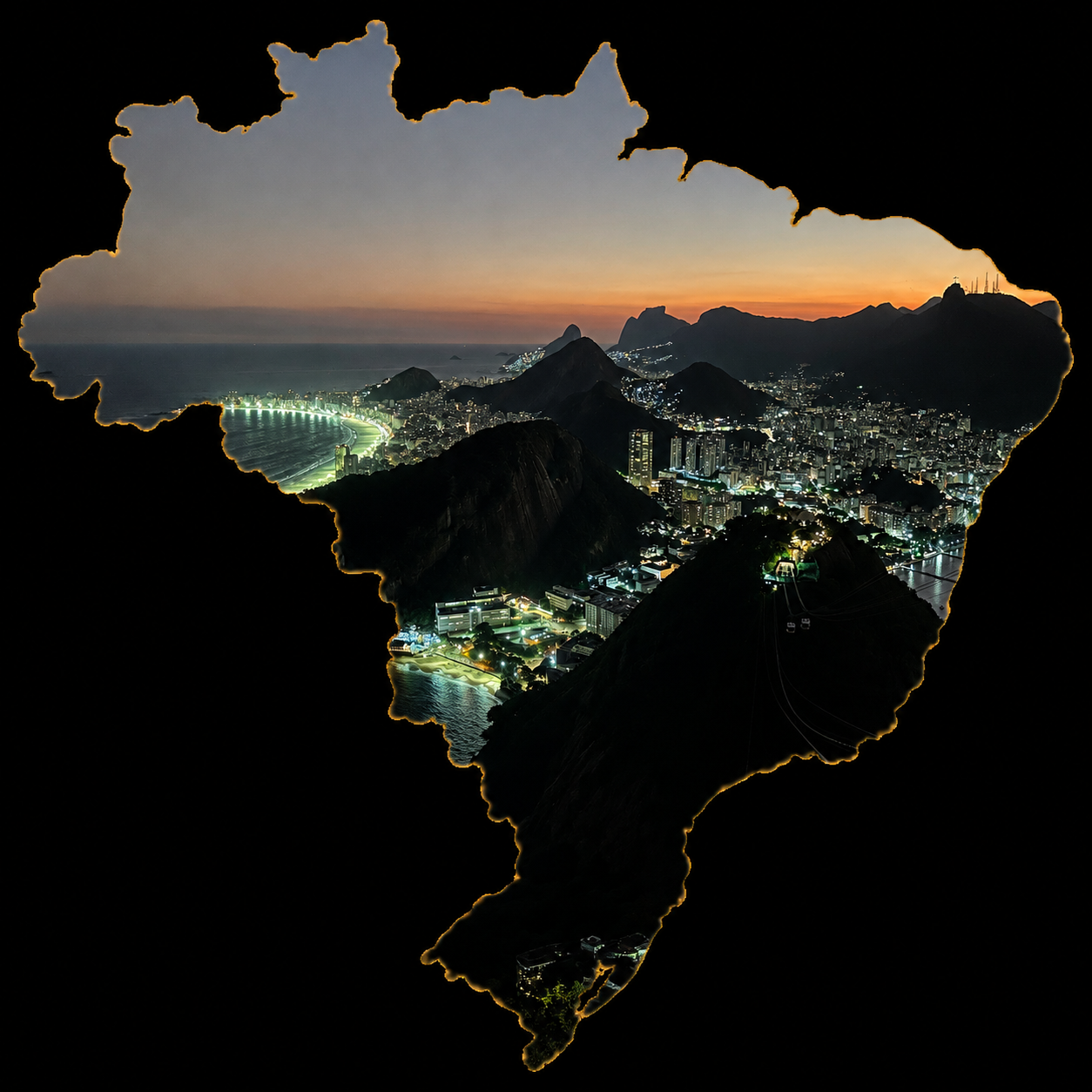
There is no team on earth that arrives at a World Cup carrying what Brazil carries. Not just a kit. Not just a roster. Brazil arrives draped in mythology—five gold stars stitched into the chest of a yellow jersey that was itself born from heartbreak. And in 2026, chasing a sixth title on North American soil, the Seleção steps onto the pitch not simply to win a football tournament but to reclaim something deeply existential: proof that the most beautiful nation in the history of the sport is still, undeniably, its greatest.
That's not sports commentary. That's Brazil.
A Jersey Born From Shame, Reborn in Glory
To understand what this World Cup means to Brazil, you have to go back to 1950. Following a devastating loss to Uruguay at the Maracanã—the loss that became known as the Maracanazo, or "The Maracanã Smash"—a Brazilian newspaper launched a design competition to create a new national team kit featuring the colors of the flag: yellow, green, blue, and white. The winning design, from Aldyr Garcia Schlee, featured a yellow shirt with a green collar, blue shorts with white trim, and white socks, debuting in 1954. That yellow jersey was more than a kit, more than a statement. It was the trademark of the most successful footballing nation on Earth, a mark of Joga Bonito, the beautiful game. For a Brazilian, to wear the crest is joy, creativity and the huge weight of a nation that expects nothing less than perfection.
Five World Cup titles followed. 1958 in Sweden. 1962 in Chile. 1970 in Mexico — the pinnacle, the one they'll argue about forever. 1994 in the United States. 2002 in Asia. Each one is a story. Each one captures a specific moment. And then: nothing. Brazil endured a 24-year cycle of near misses, quarterfinal exits, penalty shootout defeats and a soul-crushing 7-1 loss on home soil that became known as the Mineirazo. Brazil's humiliating exit from the 2014 World Cup was described as close to a national trauma in a football-crazed nation whose very identity is closely associated with its team.
That wound never fully healed. And now 2026 is the balm—or the reopening.
The Hexa Is Not Just a Trophy
In Portuguese, "hexa" means six. In Brazil, it holds immense significance. The pursuit of a sixth star is not just about football. It is about national identity, collective pride, and a desire to reclaim a throne that feels like it is theirs. The pressure from supporters and the Brazilian media is not merely enormous — it is generational. Grandmothers who wept in 1950 passed it down to daughters who watched 2014 in disbelief. Fathers who danced in the streets of Rio in 2002 now sit beside children who have never seen Brazil lift a World Cup.
Brazilian World Cup tradition centers on jogo bonito, the beautiful game philosophy emphasizing creative, attacking football. There’s a tension between style and substance, as this cultural expectation sometimes runs up against the realities of managing a tournament. In Brazil, the debate is as old as the sport: win attractively, or just win? There is, of course, one instance of jogo bonito truly winning a World Cup—the Brazil of Pelé, Jairzinho, Tostão, Rivelino, and Gérson in 1970. Every outfield player scored at least once, and the team pumped in 19 goals in six matches: individual creativity combining with structured improvisation to achieve collective success.
The 1970 Brazilian team is ingrained in the national consciousness much like jazz is in New Orleans. It's not just a memory — it's a standard. A spiritual measurement. And every Brazil squad since has been measured against it, usually found incomplete.
An Uncertain Roster, An Undeniable Stage
This uncertainty makes Brazil's prospects for 2026 both thrilling and genuinely unresolved. Brazil has been placed in Group C, where they will face Morocco, Haiti, and Scotland, with the journey kicking off on June 13 at MetLife Stadium in New Jersey—a venue where Brazilian fans are expected to turn the stands into a sea of yellow. The diaspora will show up. They always do. However, could you please clarify what exactly they are coming to watch?
The talent is not in question. Vinícius Júnior, the 25-year-old Real Madrid winger who has won two Champions League titles, arrives at the World Cup widely regarded as one of the best players in the world. Named UEFA Champions League Player of the Season in 2024, he is the centerpiece of coach Carlo Ancelotti's Brazil project and the player most capable of delivering a sixth world title. On his day, Vinicius is not just excellent — he is generationally disruptive in the way that makes defenders age in real time. He possesses Real Madrid pedigree, Champions League finesse, and an uncoachable quality: he plays with feeling. He plays like a Brazilian.
Then there is Raphinha, who has been in the form of his life under Hansi Flick at Barcelona, a player whose tenacity and technical precision make him a legitimate co-lead rather than a supporting act. And behind them, 19-year-old Endrick, currently shining on loan at Lyon, provides the raw power and goal-scoring instinct that reminds fans of a young Ronaldo Nazário. The future, if Brazil lets them use it, is sitting right there in the squad.
But the present—the now—is murky.
The Neymar Question Nobody Wants to Answer
For over a decade, the conversation about Brazil began and ended with Neymar. Brazil's all-time top scorer. He’s the bridge generation between Ronaldo and Vinicius. The man who has carried the weight of Brazil's six World Cup dreams across three tournaments, enduring a broken vertebra here, a torn ACL there, and a nation's longing draped across his shoulders each time, is here. He arrives at what is likely his final World Cup, having returned to his boyhood club Santos in January 2025 following an injury-plagued spell at Al-Hilal. He has not played for Brazil since suffering an ACL tear in October 2023.
Ancelotti has included him in the squad, a decision laden with sentiment and risk in equal measure. Vinícius Júnior, who called Neymar one of his idols, said the pressure on him is normal — acknowledging that Neymar is the all-time scorer for the greatest national team in the world. And Rodrygo, despite his injury keeping him out, offered a passionate defense of Neymar's symbolic and emotional weight, suggesting that a potential sixth world title for Brazil would feel incomplete without the presence of their legendary number 10.
That's not analytics talking. That's Brazil talking — a country where football is not merely a game but a story, and the best stories need their storytellers.
The honest and unresolved question is whether Neymar can still be that storyteller, physically. He is also battling the cruelest of timelines: the man who defined an era now has to prove he can still play in one. If he cannot, Brazil must collectively let go—mid-tournament, mid-mission—and that psychological shift could define the Seleção's entire fate.
A European Coach, A Brazilian Dream
Adding another layer of complexity to this year's campaign is the man on the sideline. Carlo Ancelotti, Brazil's coach since May 26, 2025, is the first permanent foreign boss for the Seleção. He is an Italian who has won five Champions League titles. He is a man devoid of Brazilian heritage, devoid of a childhood steeped in carnival rhythms, and devoid of an ancestral comprehension of the essence of jogo bonito. And yet he may be precisely what this team needs.
Vinícius has explained the transformation in detail, pointing to the renewed confidence. Ancelotti has instilled this belief: "He's done the same thing everywhere he's gone—instilling confidence and getting the best out of every player in their ideal positions." He always says his dream is to make the Brazilian people content, to bring back the joyful football that defines us, and to win the World Cup. He gives us calm and confidence."
Calm. Brazil has often been devoid of that crucial element. In 2014, there was panic. In 2022, there was confusion. Ancelotti offers something radical for this Seleção: the unflappable steadiness of a man who has won everything and fears almost nothing. Having extended his contract until 2030, he has successfully integrated a dual-speed system: a disciplined defensive block that allows the creative attackers total freedom forward.
Whether that translates to a World Cup title remains the sport's greatest question. He has never won a World Cup. No player has won a World Cup unless they were born in a footballing nation. However, it is poetic that a man who built his legacy on unlocking genius is now being handed Vinicius, Raphinha, Neymar, and Endrick all at once.
Yellow in the Stands, Green in the Heart
Whatever happens on the pitch, one truth is already certain: the Brazilian diaspora in North America — from Newark to Miami, from Toronto to Los Angeles — will transform this World Cup into something more than a tournament. As the only nation to have appeared in every World Cup tournament ever played, expectations permanently position Brazil among the favorites. But their presence extends far beyond expectation. It is felt in the neighborhoods, in the samba drums outside the stadiums, and in the Portuguese conversations that spill from sports bars onto city streets.
Brazil doesn't just travel to the World Cup. Brazil becomes the World Cup, wherever it goes.
Hexa is more than a number. It is a reckoning—with history, with heartbreak, with the promise that somewhere inside this flawed, brilliant, uncertain squad is the spirit of 1970, waiting to be reclaimed. The yellow shirt carries the weight of an entire nation's identity, and in 2026, that weight is heavier than ever.
The beautiful game belongs to Brazil. Whether Brazil can prove it one more time—that's the question every nation on Earth will be watching to see answered.
Kathia Woods is an entertainment journalist, film critic, and founder of Cup of Soul Show. She covers culture at the intersection of sport, identity, and the Black diaspora.