
DISCLOSURE DAY
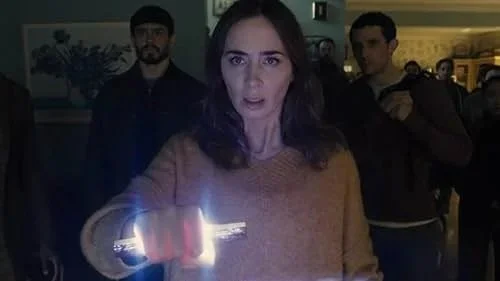
There is a particular kind of surrender that happens when Steven Spielberg is operating in his element. You don't just watch his films—you get absorbed into them, carried by a current that is part spectacle, part pure emotional engineering. Disclosure Day is not Spielberg's maximum voltage. But it is Spielberg remembering who he is, and in 2026, that reminder lands with considerable force.
The premise is deceptively simple, even if the execution unfolds on an epic scale. A massive government conspiracy begins to unravel as a targeted whistleblower races against time to bring about the extraordinary event that will change human history forever — the day of ultimate alien disclosure. At the center of it all is Margaret Fairchild, a Kansas City, Missouri, TV meteorologist and former journalist who has inexplicably begun speaking languages she has never known—including one that is clearly not of this world. She is guided by forces she doesn't understand but that bring her a strange, unexpected comfort.
That role belongs to Emily Blunt, and she delivers what is unquestionably one of the finest performances of her already-remarkable career. The task asks everything of her confusion, awe, terror, grief, and ultimately a kind of transcendence and she meets every demand without once letting you see the seams. What makes Blunt extraordinary here isn't the moments of intensity, though those are electric. It's the quieter passages in between, the way she holds uncertainty in her body while the world around her dissolves into the unimaginable. She is the film's gravitational center, and Disclosure Day earns every emotional payoff it reaches for largely because she makes you believe it.
Josh O'Connor, cast as Daniel Kellner, the scientist Fairchild is mysteriously drawn toward, continues his extraordinary run of taking big swings in unexpected spaces. After Challengers and La Chimera, here he is again — restless, searching, refusing to coast. The heart of the film is channeled through deeply felt performances from Blunt and O'Connor, and their dynamic, built on shared bewilderment rather than conventional chemistry, gives the film its emotional architecture. O'Connor doesn't play Kellner as a hero. He portrays him as a man being asked to become one, and that distinction matters.
Colin Firth plays Noah Scanlon, head of the Wardex Corporation, who is convinced the world would succumb to fear and doom should the truth get out—and he is genuinely compelling in a role that could easily have been pure villain. By the time the film reaches its climax, we understand his motivations even as we oppose them. Firth lends Scanlon the kind of mannered certainty that makes him more frightening than any monster. Colman Domingo, as Hugo Wakefield, the orchestrator working in the opposite direction, serves as a compassionate advocate for full disclosure and brings the moral weight the film needs in its final act. Both are steady presences—anchors holding the larger architecture in place without needing to dominate it.
What is Spielberg doing with all of this? Something quieter than you might expect. Awestruck innocence now co-exists with a more ruminative maturity, particularly in how the film handles governmental secrecy, manipulation, and deception. This is not the wide-eyed rapture of Close Encounters or the childhood wonder of E.T. It is something more tempered — a filmmaker in his late seventies returning to his most sacred genre and asking harder questions about whether humanity deserves the answers it seeks.
That is, ultimately, what makes Disclosure Day resonate long after the spectacle fades. Spielberg, the craftsman, has never been in question. What is striking here is Spielberg the philosopher—working in a more subdued register, trusting his cast to carry the weight. It is not his loudest film. It may be one of his most honest.
Disclosure Day comes to theaters on June 12th