
Christopher Nolan's 'The Odyssey' Is Epic Filmmaking with Familiar Blind Spots
Christopher Nolan doesn't do small, and "The Odyssey" may be the biggest swing of his career. Shot entirely on IMAX film cameras across Morocco, Greece, Italy, Iceland, and Scotland, his adaptation of Homer's epic is a monument to old-school, in-camera spectacle. It's frequently breathtaking, occasionally exhausting, and ultimately satisfying even if it never quite reaches the heights of his best work.
Matt Damon anchors the film as Odysseus, the king of Ithaca clawing his way home after the Trojan War, and he's rock-solid. This is his third collaboration with Nolan, and the trust between them shows. Damon plays Odysseus not as a marble statue come to life but as a weary strategist a man whose cleverness has cost him as much as it has saved him. He carries the physical toll of the journey in his frame and the guilt of it in his eyes. It's not showy work, but it's the kind of sturdy, grounded performance this material needs to keep three hours of gods and monsters tethered to something human.
The revelation here, though, is Tom Holland. As Telemachus, the son who has spent his entire life in the shadow of a father he's never known, Holland delivers his best performance outside of the Spider-Man franchise. Freed from quips and CGI webs, he gets to play yearning, resentment, and hard-won courage, and he rises to every moment. His scenes defending the throne of Ithaca and his mother from the circling suitors give the film its emotional spine. If anyone doubted Holland had a career beyond Peter Parker, his performance should settle it.
Anne Hathaway, reuniting with Nolan after "The Dark Knight Rises" and "Interstellar," makes Penelope far more than the patient wife of legend. Her Penelope is a chess player running out of moves, holding off Robert Pattinson's oily Antinous and a palace full of vultures with nothing but wit and will. Hathaway finds the steel underneath the grief, and her scenes opposite Holland are among the film's finest.
This makes it all the more frustrating that Penelope is the only exception. Nolan has long had a women problem, and "The Odyssey" doesn't solve it. For a story stocked with some of mythology's most formidable female figures, the film treats most of them like background dancers. Zendaya's Athena, Charlize Theron's Circe, Lupita Nyong'o's Helen of Troy/Menelaus's wife, and Samantha Morton's Circe are all striking presences beautifully lit, briefly deployed, and gone before they register as full characters. In a source text where women hold genuine narrative power, watching this much talent reduced to divine set dressing feels like a missed opportunity Nolan should have outgrown by now.
The film's secret weapon is John Leguizamo as Eumaeus, the loyal swineherd who never stopped believing his king would return. Leguizamo is flat-out charming, bringing warmth and humor to a film that badly needs both. Whenever he appears on screen, "The Odyssey" becomes more relaxed.
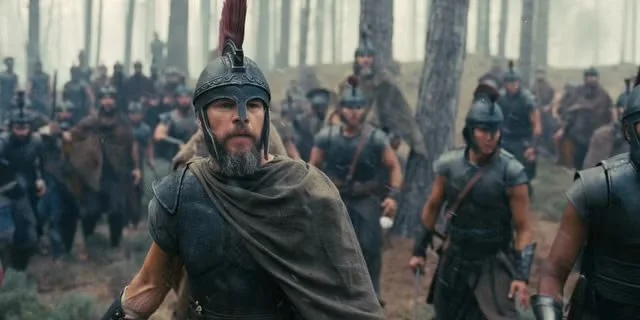
The film's technical aspects are impeccable. Hoyte van Hoytema's cinematography is outstanding wine-dark seas that swallow the frame, torch-lit halls, and coastlines that look carved by the gods themselves. The battle sequences are truly epic, with the fall of Troy and the final reckoning in Ithaca presented on a scale and with a clarity that surpasses most modern blockbusters. And Ludwig Göransson delivers another amazing score, weaving ancient textures into his signature propulsive sound. Between these two films and "Oppenheimer," he has become as essential to Nolan's films as the IMAX cameras.
The problem sits in the middle. Once Odysseus is bouncing from island to island temptation here, monster there the film starts to drag. Nolan's fractured-timeline instincts, usually his greatest asset, work against the episodic nature of Homer's story, and a stretch of the second act feels like wandering for wandering's sake. You feel every minute of the runtime during that middle hour.
The ending then arrives, bringing everything together. The threads Nolan has been laying father and son, king and kingdom, and the stories we tell about the men who leave and the women who wait converge in a finale that earns its emotion honestly. It's the rare Nolan climax that hits the heart before it hits the head.
Is "The Odyssey" Christopher Nolan's best film? No. "Oppenheimer" and "Dunkirk" remain stronger, tighter achievements, and the sidelining of its women keeps this one from true greatness. But it's a towering piece of craftsmanship with two standout performances in Damon and Holland, a scene-stealing turn from Leguizamo, and a final act that justifies the voyage. Nolan fans will walk out satisfied and everyone else will at least walk out impressed.
The Odyssey sails into theaters world wide on July 17th.